Kaneiji Temple, Ueno: A Visitor's Guide
Quick answer
- Kan'ei-ji is the Tokugawa shoguns' temple in Ueno, founded in 1625.
- The grounds and outer hall are free.
- The ceiling can be seen 10:00 to 16:00 on days marked on the temple's calendar, and photos are not allowed inside.
Kaneiji Temple at a Glance
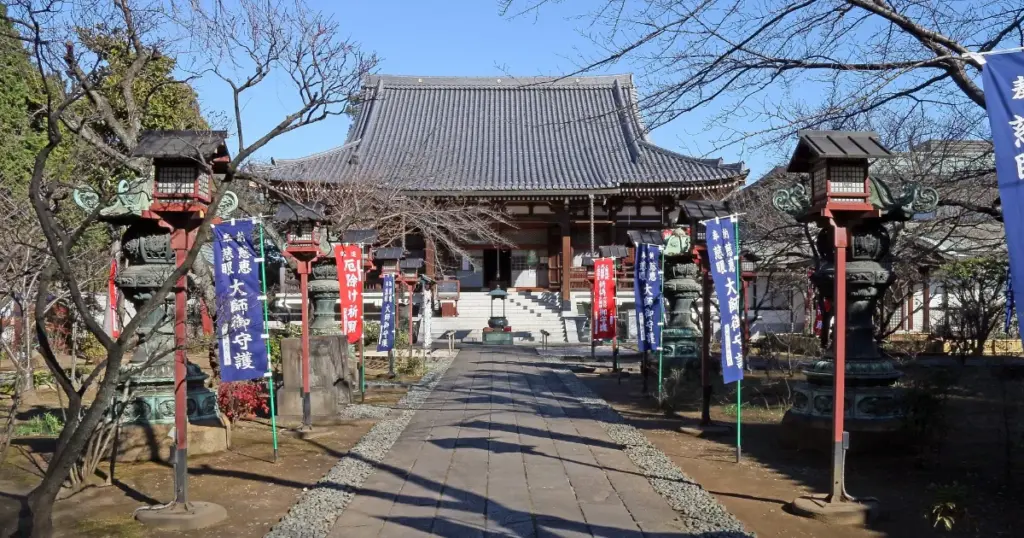
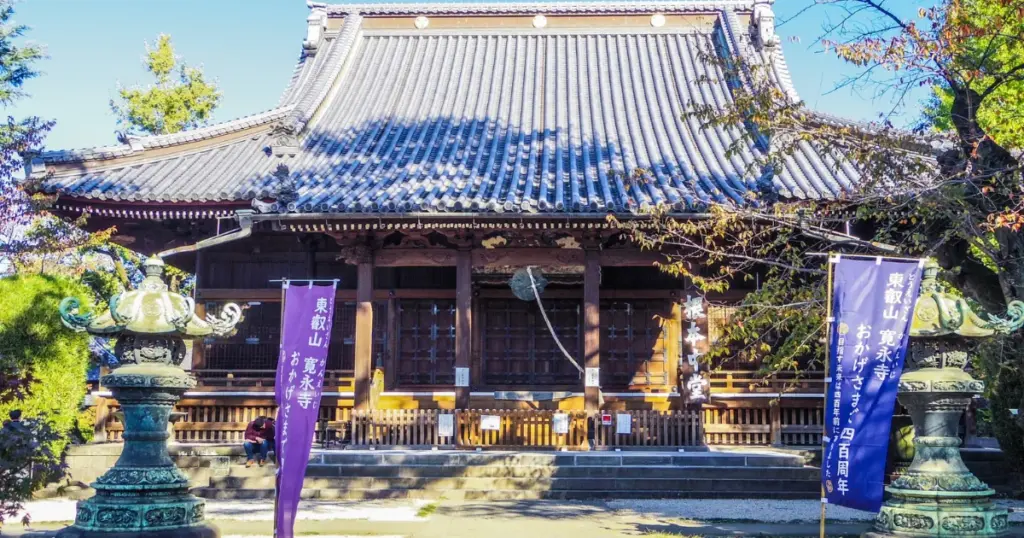
Kan'ei-ji (often written Kaneiji) is a Tendai Buddhist temple on the north side of Ueno Park, founded in 1625 to protect Edo Castle and later the family temple of the Tokugawa shoguns. Today it has two parts, a quiet main temple in the Ueno Sakuragi neighbourhood and a set of halls scattered across Ueno Park that most visitors walk past without knowing they belong to the same temple.
| Fact | Detail |
|---|---|
| Main hall (Konponchudo) | Gates open 9:00 to 17:00, hall open 10:00 to 16:00 |
| Dragon ceiling viewing | ¥500, free for high-school age and under |
| Photos | Allowed outside, not allowed inside the halls |
| Nearest station | JR Uguisudani (South Exit), about 7 minutes |
| Time needed | 30 to 45 minutes at the main hall, 1.5 to 2 hours with the park halls |
The temple marked its 400th anniversary in 2025, and the biggest change for visitors is a new ceiling painting of two dragons inside the main hall, open to the public since December 2025. For everything else in the area, see our guide to things to do in Ueno.
A Short History of Kan'ei-ji
Kan'ei-ji was built as Edo's spiritual guard and grew into one of the largest temples in Japan, until a single day of fighting in 1868 destroyed most of it.
Founded to Guard Edo Castle
The monk Tenkai, adviser to the first three Tokugawa shoguns, founded the temple in 1625 on the Ueno hill, to the northeast of Edo Castle. In Japanese belief the northeast is the direction misfortune comes from, and Tenkai modelled the temple on Enryaku-ji on Mount Hiei, which guards Kyoto's palace from the same direction.
That is where the temple's full name comes from, Toeizan, "the Mount Hiei of the east", and Kan'ei-ji, after the Kan'ei era in which it was founded.
The Shoguns' Temple
From 1680, when the fourth shogun Ietsuna was buried here, Kan'ei-ji was also a family temple of the Tokugawa. In all, six of the fifteen shoguns rest here.
At its height the temple covered about 305,000 tsubo (roughly a square kilometre), essentially the whole of today's Ueno Park, with 36 sub-temples and a main hall 32 metres high where the park's fountain now plays.
The Battle of Ueno and After
In 1868, shogunate loyalists made their last stand in Tokyo on the temple grounds, and the fire of the Battle of Ueno burned the main hall and most of the buildings. The new government took the land, and in 1873 it became Ueno Park.
In 1879 the temple was allowed to rebuild on the site of one of its sub-temples, and a hall was moved here from Kita-in temple in Kawagoe to become the new main hall. Our Ueno Park guide covers how the temple grounds became the park.
The Twin Dragon Ceiling in the Main Hall
The main reason to visit Kan'ei-ji in 2026 is Eigaku Soryu, "Twin Dragons of the Eastern Hiei", a ceiling painting about 6 metres by 12 metres by the painter Yuji Tezuka, dedicated for the 400th anniversary. Until it was installed, the inner part of the main hall (the chujin) had never been open to the public.
The painting was made directly on the huge ceiling boards over several years, toured exhibitions in 2024 and 2025, and had its eyes painted in at the anniversary ceremony on 10 October 2025. It is now fixed above the inner hall.
As of October 2026, the viewing works like this.
- Hours. 10:00 to 16:00, last entry 15:40.
- Fee. ¥500 for the inner hall. High-school students and younger are free (ID may be requested).
- Dates. Only on days marked with a dot on the temple's monthly calendar. On days with services or groups, only the free outer hall is open, and some days close early.
- Rules. No photos inside, no food or drink, and no heating or air conditioning in the hall.
Check the official viewing calendar the day before you go. If you only want to pray, buy a charm or draw a fortune, the outer hall is free.
 ONO
I recommend Kaneiji to families.
Kan'ei-ji Halls Inside Ueno Park
Several of the temple's halls stand inside Ueno Park, and they are easier to fit into a family day than the main hall, because you pass them on the way to the zoo and the museums.
1. Kiyomizu Kannon-do
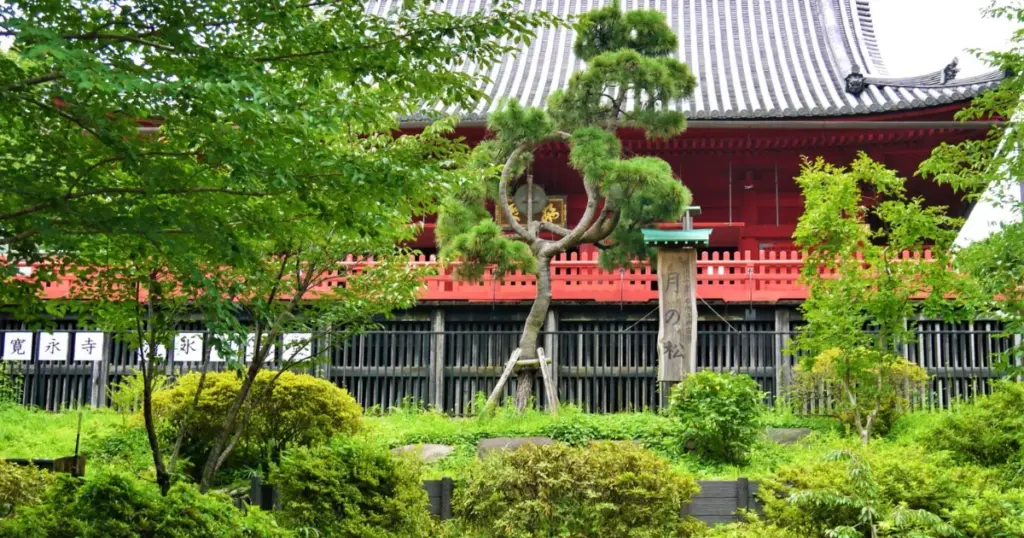
Built in 1631 and moved to its present spot in 1694, this is one of the few buildings that survived the Battle of Ueno, and it is an Important Cultural Property. It copies the wooden stage of Kiyomizu-dera in Kyoto, on a smaller scale, and looks down over Shinobazu Pond.
In front of it is the "Moon Pine", a pine trained into a circle that appears in Hiroshige's woodblock prints. It was lost in a storm in the Meiji period and replanted in 2012.
The hall's Kannon is prayed to for children and safe childbirth. Every year on 25 September it holds a memorial service for dolls, where people bring dolls they can no longer keep. The hall is open 9:00 to 17:00.
2. Shinobazu Pond Bentendo
The eight-sided hall on the island in Shinobazu Pond is dedicated to Benten, goddess of music, eloquence and good fortune. Tenkai placed it here to echo Chikubushima, the island in Lake Biwa.
The original burned in 1945, and the present hall was rebuilt in 1958. It is open 9:00 to 17:00, and you reach it on foot along a causeway, so it works with a stroller.
3. Ueno Daibutsu, the Great Buddha Face
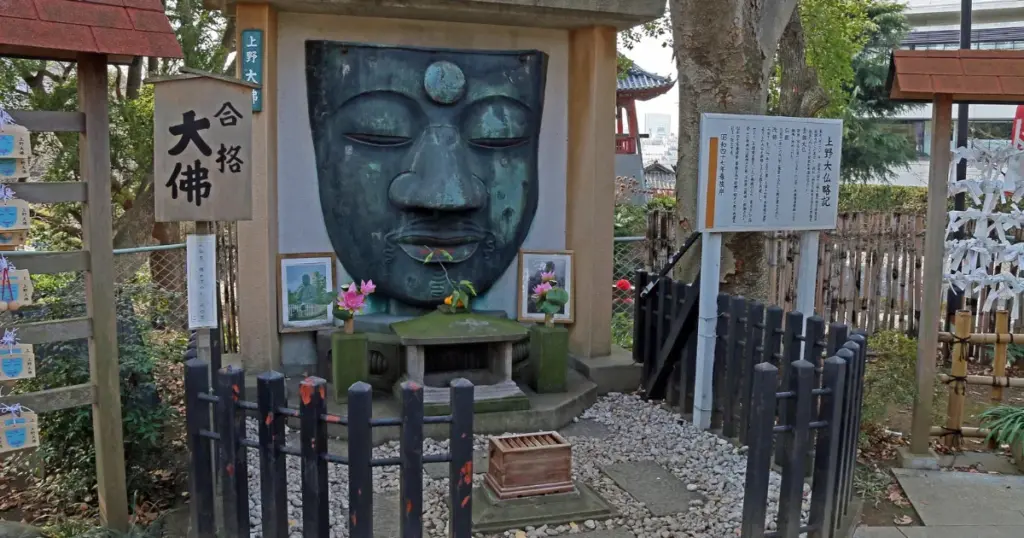
On a small hill near the Seiyoken restaurant is the face of a Buddha that once sat about six metres tall. First made in 1631, it was damaged by earthquakes and fire over the centuries, collapsed in the 1923 Great Kanto Earthquake, and only the face was kept.
Because the face "will fall no further", students come here to pray for exam success, and the wooden prayer plaques beside it are full of their wishes. Beside it is a small pagoda built in 1966.
4. The Five-Storey Pagoda
The temple's five-storey pagoda, rebuilt in 1639 after a fire, stands inside Ueno Zoo. You can see it from the zoo's East Garden, but you cannot go inside.
See our Ueno Zoo guide for tickets and the route.
Other Sights at the Main Temple
Around the main hall, a few more parts of the temple are worth a few minutes.
- Kaizando (Founder's Hall). Dedicated to Tenkai and the earlier monk Ganzan Daishi, known together as the "Two Great Masters". On the 3rd of every month it holds a fire ritual (goma) at 14:00 that anyone may attend, and twice a month it offers temple experiences such as goma or zazen. Ask the hall for dates.
- The Tokugawa mausoleums. The graves of the six shoguns are not generally open, but the ornate gates of the mausoleums of Ietsuna and Tsunayoshi, Important Cultural Properties, can be seen from the road behind Tokyo National Museum.
- The old front gate of the Rinnoji residence. A surviving Edo-period gate near the museum, also an Important Cultural Property.
- Goshuin (temple seals). Written at the seal office beside the temple office, 10:00 to 16:00, including designs based on the dragon ceiling. Current designs are posted on the temple's Instagram.
Visiting Kan'ei-ji with Children
Kan'ei-ji is a working temple and a quiet one, so it suits children who are happy to look and whisper for half an hour. Younger children usually get more from the halls in the park, where there is a pond, a stage over the water and a giant Buddha face, than from the main hall.
- Free entry for under-18s makes the dragon ceiling easy to add if older children are interested in dragons or art.
- Shoes come off inside the halls. Bring socks in winter. The main hall has no heating.
- Strollers stay outside the halls. The roads around the main hall are flat but narrow, with a one-way road for cars.
- No photos inside applies to everyone, including phones. Explain it to children before you go in.
- Toilets and cafés are easier to find in Ueno Park and at Tokyo National Museum than at the main temple.
Please treat every hall as a place of prayer. Speak quietly, do not climb on stones or monuments, and keep the Buddha face and the graves out of jokes and poses.
How to Get to Kan'ei-ji
The main hall (Konponchudo) is at 1-14-11 Ueno Sakuragi, Taito City, closest to JR Uguisudani Station, not Ueno Station.
- From JR Uguisudani (South Exit), about 7 minutes. Turn right out of the gate, climb the Shinzaka slope and follow the one-way road between the Kan'ei-ji cemetery and the back of Tokyo National Museum.
- From JR Ueno (Park Exit), about 15 minutes. Walk through Ueno Park past the Tokyo National Museum.
- From Nezu Station (Tokyo Metro Chiyoda Line), about 15 minutes. The way is uphill and links well with a walk through Yanaka and Nezu. See our Yanaka and Nezu guide.
The halls in the park are near Ueno Station. Kiyomizu Kannon-do and the Buddha face are about 5 minutes from the Park Exit, and Bentendo is by Shinobazu Pond.
Note that the dragon ceiling is only at the main hall in Ueno Sakuragi, not in the park.
A Half-Day Route Around Kan'ei-ji
The easiest way to see the temple is to walk it from south to north, from the park halls to the main hall, which takes about 2 hours at a family pace without the museums.
- Bentendo on Shinobazu Pond (from Keisei Ueno or the Shinobazu side of the park).
- Kiyomizu Kannon-do and the Moon Pine, up the steps from the pond.
- Ueno Daibutsu, a short walk north.
- Through the park past Tokyo National Museum. See our Tokyo National Museum guide if you plan to go in.
- Konponchudo and the dragon ceiling, then Kaizando.
- On to Yanaka for a snack and the shopping street, or back to the zoo.
The zoo and most museums close on Mondays, so plan the zoo half of the day for another day of the week. If you would rather have the walk, the timings and the lunch stop planned for you, our private Tokyo tour with kids can build a day around Ueno, and you can see all our tours in Tokyo.
For more ideas across the city, see things to do in Tokyo with kids.
Frequently Asked Questions
- Is Kaneiji Temple free?
-
The grounds and the outer part of the main hall are free. Seeing the inner hall and its dragon ceiling costs ¥500 for adults. High-school students and younger are free.
- What are Kaneiji Temple's opening hours?
-
The gates are open 9:00 to 17:00. The main hall is open 10:00 to 16:00, with last entry for the ceiling at 15:40. Kiyomizu Kannon-do and Bentendo are open 9:00 to 17:00.
- Can you take photos at Kaneiji?
-
Yes, outside. Photography is not allowed inside the main hall, so you cannot photograph the dragon ceiling.
- What is the nearest station to Kaneiji Temple?
-
JR Uguisudani Station on the Yamanote Line, about 7 minutes from the South Exit. JR Ueno's Park Exit and Nezu Station are each about 15 minutes away.
- Can you visit the Tokugawa shoguns' graves?
-
Not usually. The mausoleums are closed to the public except for occasional special openings announced by the temple, but the gates can be seen from outside.
- How long do you need at Kaneiji?
-
Allow about 30 to 45 minutes for the main hall and the ceiling, and 1.5 to 2 hours to add Kiyomizu Kannon-do, Bentendo and the Buddha face in Ueno Park.
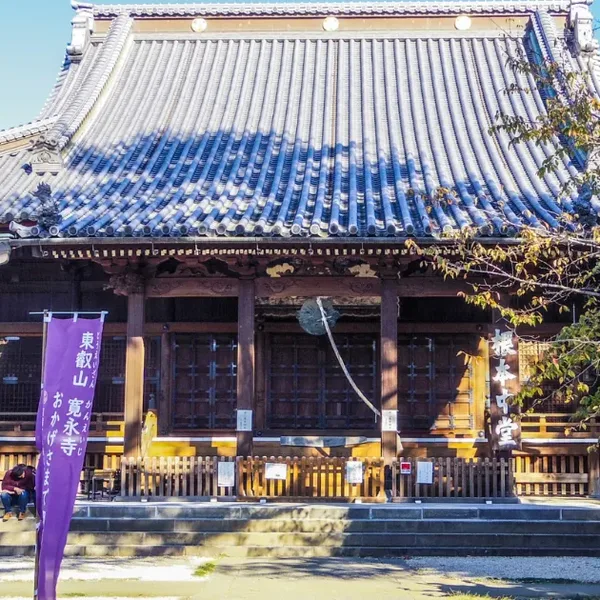
Kan'ei-ji Temple
Address
1-14-11 Uenosakuragi, Taito City, Tokyo 110-0002
Nearest station
Uguisudani Station (JR Yamanote / Keihin-Tohoku)
Sources
https://kaneiji.jp/tenjyo_schedule
https://kaneiji.jp/access
https://kaneiji.jp/about2
https://kaneiji.jp/about3
https://kaneiji.jp/400thanniversary
https://www.mlit.go.jp/tagengo-db/R1-00088.html
Plan a Private Day with a Local

Every tour is private, for your group only, and planned with you before you arrive. From US$550 per group for a day on foot in Tokyo or Yokohama, or from US$890 for a day trip by train to Kamakura, Hakone or Mt. Fuji. Travelling with children? See our Tokyo private tour with kids.
Free Consultation

Japan Trails Newsletter
Free Newsletter Sign‑Up
Subscribe to our newsletter and receive a handpicked list of restaurants that Japanese locals go to.
-
 Gyusuki and Yakiniku Bento: Two Kinds of Beef in One Ekiben
-
 Naritasan Shinshoji Temple: A Visitor's Guide with the Omotesando
You might also like
-
 Ameyoko Market, Tokyo: A Guide for First-Time Visitors
-
 National Museum of Nature and Science, Ueno (Tokyo): Visitor Guide with Kids
-
 National Museum of Western Art, Tokyo: A Visitor's Guide
-
 Yanaka and Nezu, Tokyo: A Walking Guide to the Old Town
-
 Ueno Zoo Tokyo: A Family Guide for 2026
-
 Kappabashi Street: Tokyo's Kitchen Town, with Kids
-
 Things to Do in Ueno, Tokyo: A Family Guide
-
 Tokyo National Museum: A Visitor Guide for Families