Yushima Seido and Hijiri Bridge: A Walk Through Ochanomizu
Quick answer
- Yushima Seido is a Confucian shrine founded in 1690, free to enter and open 9:30 to 17:00 (16:00 in winter).
- Its main hall, the Taiseiden, opens inside only on weekends and public holidays.
- Hijiri Bridge next door is the best place in central Tokyo to watch three train lines cross at once.
What Are Yushima Seido and Hijiri Bridge?
Yushima Seido is a Confucian shrine and former academy in Ochanomizu, central Tokyo, and Hijiri Bridge is the arched bridge over the Kanda River right beside it. They sit at the top of a short walk that ends at Kanda Myojin and Akihabara, and together they make a quiet, free hour away from the crowds.
Yushima Seido is not a Buddhist temple or a Shinto shrine. It was built to honour Confucius, and for most of the Edo period it was where the shogun's government trained its scholars and officials.
Hijiri Bridge, built in 1927, links it with a second sacred building on the opposite bank, the Russian Orthodox Nikolai-do cathedral. Between the two, the river runs in a deep green cutting, and trains on three lines cross it below your feet.
The History of Yushima Seido
Yushima Seido began in 1690, when the fifth Tokugawa shogun, Tsunayoshi, built a hall for Confucius here to promote Confucian learning. He moved in the shrine and the private school of the Hayashi family of scholars from Ueno.
About a century later, in 1797, the shogunate turned the school into its own official academy, the Shoheizaka Gakumonjo. For the rest of the Edo period it trained officials in Confucian ethics and government, the values that shaped how Japan was run.
After the Meiji Restoration the school closed in 1871, but the site stayed at the centre of education. In the same years it housed Japan's first museum (the forerunner of today's Tokyo National Museum), its first public library, and the teacher-training schools that grew into Tsukuba University and Ochanomizu University.
That is why it is often called the birthplace of modern education in Japan.
The 1923 Great Kanto Earthquake burned everything except the Nyutoku-mon gate and a small water pavilion. The buildings you see now were rebuilt in 1935 in reinforced concrete, modelled on the 1790s design, and restored again between 1986 and 1993.
What to See at Yushima Seido
The grounds are compact, and you can walk from the front gate to the main hall in a few minutes. Stop for the four things below.
1. The Nyutoku-mon gate
The wooden Nyutoku-mon is one of only two structures that survived the 1923 earthquake. Its name means "the gate of entering virtue", and its dark wood without bright paint sets the tone for the rest of the site.
2. The Taiseiden (main hall)
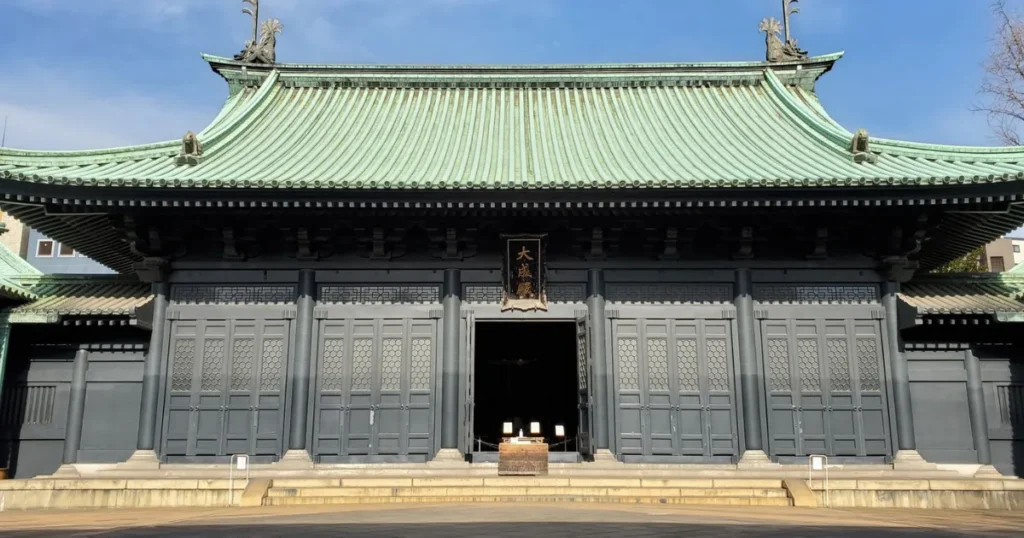
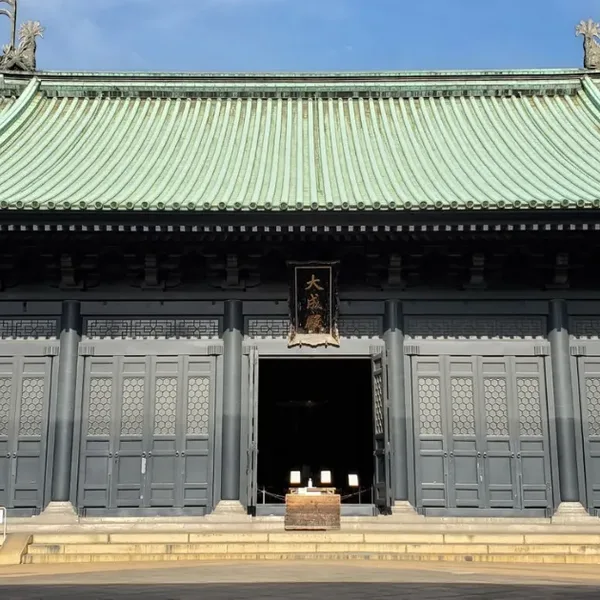
The Taiseiden is the main hall, dedicated to Confucius. Its black exterior differs from the red and gold of most Tokyo shrines and temples, because it was built as a place of study.
Look up at the roof ridge for the bronze guardian creatures at each end.
The inside of the hall opens only on Saturdays, Sundays and public holidays, from 10:00. A small entry charge applies, which you can check at the hall.

3. The statue of Confucius
A large bronze statue of Confucius, a gift from Taiwan, stands among the trees near the gate. It is the image most visitors photograph.
4. Prayer plaques for exams
Because of its link with learning, students come here to pray for success in entrance exams, especially in winter, and hang wooden prayer plaques (ema). Look, but do not touch other people's plaques.
Opening Hours, Fees and Rules
The grounds of Yushima Seido are free and open every day from 9:30, except in mid-August and at the end of the year. These are the times published by the Shibunkai, the foundation that cares for the site.
| Hours or dates | |
|---|---|
| Grounds (summer) | 9:30 to 17:00 |
| Grounds (winter) | 9:30 to 16:00 |
| Taiseiden interior | Saturdays, Sundays and holidays, 10:00 to closing |
| Closed | 13 to 17 August and 29 to 31 December |
- There is no parking, so come by train or bus.
- It is still a place of worship for Confucius, with ceremonies held through the year. Keep voices down near the Taiseiden.
- There are no food stalls, and food should be eaten outside the grounds.
Hijiri Bridge and Its Train View
People stop on Hijiri Bridge for one view, three train lines crossing the Kanda River at once, right below you. From the middle of the bridge, the orange Chuo Line and yellow Sobu Line trains run along the cutting into JR Ochanomizu Station, and the red Marunouchi Line subway train comes out of its tunnel and crosses the river on its own short bridge before disappearing into the bank again.
Children who like trains can stand here for a long time. A Marunouchi train appears every few minutes, and they can try to catch all three colours in one photo.
The bridge itself dates from 1927 and was one of the bridges rebuilt after the Great Kanto Earthquake. It is a reinforced concrete arch 92 metres long and 22 metres wide, and its arch inspired other bridges in Tokyo.
Its name, "sacred bridge", comes from the two sacred buildings it joins, Yushima Seido to the north and Nikolai-do to the south.
- Best time. Go in the daytime for the trains. At night the arch is lit up.
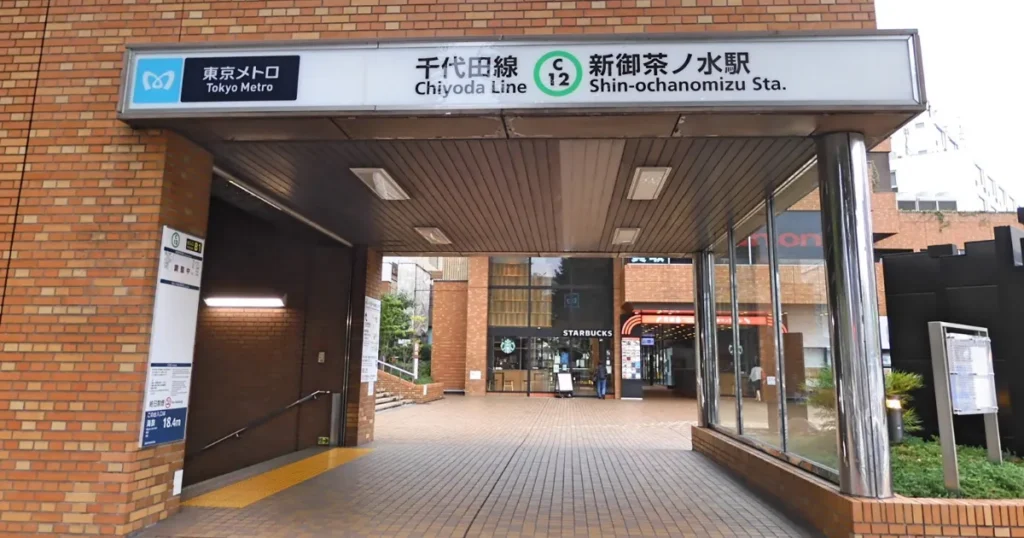
- Getting on the bridge. Use the Hijiribashi exit of JR Ochanomizu Station, or exit B1 or B2 of Shin-Ochanomizu on the Chiyoda Line.
 ONO
I recommend this area, especially for families with someone facing exams. Yushima Tenjin nearby enshrines the god of learning.
Nikolai-do, the Cathedral at the Other End
At the south end of Hijiri Bridge, a minute's walk away, stands Nikolai-do (Holy Resurrection Cathedral), Japan's best-known Russian Orthodox cathedral, with a green dome. It is an active church, so it opens to visitors only at set times.
In October 2026 visiting hours are 13:00 to 15:30 on open days, with an admission fee of ¥300. It closes on most Mondays and on other days marked in its calendar, and services come first, so check the cathedral's calendar before you go.
How to Get to Yushima Seido
Yushima Seido is a 1- to 2-minute walk from three stations, and the JR station is about 5 minutes from Tokyo Station on the Chuo Line rapid.
| Station | Line | Walk |
|---|---|---|
| Ochanomizu | Tokyo Metro Marunouchi | About 1 min |
| Ochanomizu | JR Chuo and Sobu lines | About 2 min (Hijiribashi exit) |
| Shin-Ochanomizu | Tokyo Metro Chiyoda | About 2 min |
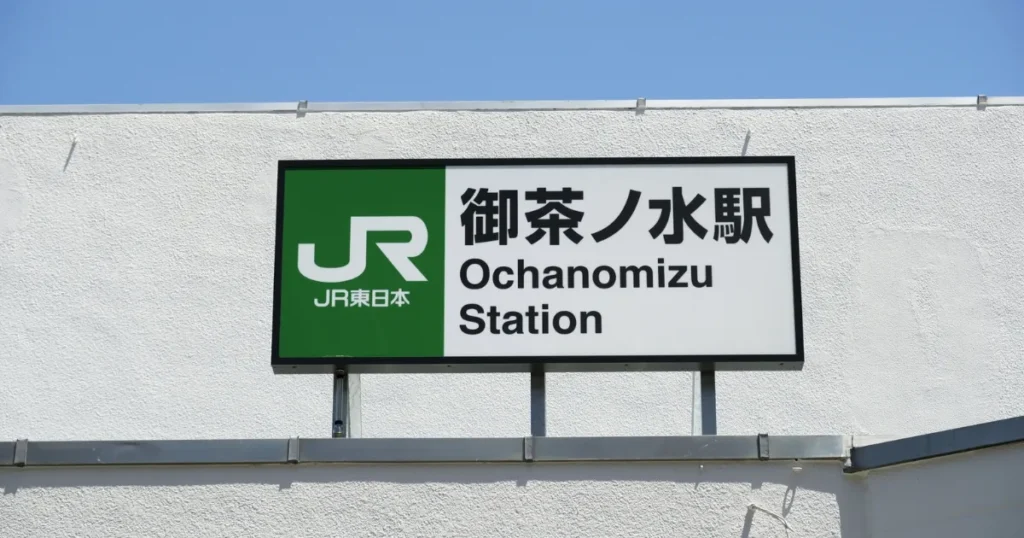
The address is 1-4-25 Yushima, Bunkyo City. JR Ochanomizu Station sits on a slope above the river, and its exits are spread out. For this walk, use the Hijiribashi side.
Ochanomizu Walking Route from the Bridge to Akihabara
The easiest route runs downhill from Ochanomizu to Akihabara in about 90 minutes with stops, and it is under 2 km in all.
- JR Ochanomizu Station, Hijiribashi exit. Step out and you are at the bridge.
- Hijiri Bridge. Spend ten minutes watching the trains.
- Yushima Seido. Cross the bridge and the gate is on your right. Allow 20 to 30 minutes.
- Kanda Myojin. Leave by the north side of the grounds, and the front torii of this shrine, one of Tokyo's oldest, is just across the road. Our Kanda Myojin guide covers its deities, charms and museum.
- Akihabara. Walk about 7 minutes downhill to the anime and game shops. Our Akihabara guide picks the best stops for children and teens.
Doing it in this order means the morning is quiet and the shops in Akihabara, which open later, are open when you arrive. If you start from Akihabara instead, the walk to Ochanomizu is all uphill.
Visiting with Kids
This walk suits children who like trains or who need a calm stop between busy places. Yushima Seido itself is quiet and shady, with space to walk, but has nothing built for children, so the bridge and the shops at the end will hold their interest longer.
- Strollers. The walk is on pavements, with slopes and a few steps inside Yushima Seido. Station lifts are easiest at JR Ochanomizu and Shin-Ochanomizu, but check the exit before you go.
- Toilets. Use the stations or Kanda Myojin.
- Timing. Go on a weekday morning for the quietest visit, or at the weekend if you want to see inside the Taiseiden.
If you would like a day in Tokyo planned around trains, shrines and the shops your children care about, our private Tokyo tour with kids is built for that. For more ideas, see things to do in Tokyo with kids and our tours in Tokyo.
Nearby Jimbocho and Kanda
Ochanomizu sits between two neighbourhoods that are easy add-ons. Jimbocho, 10 to 15 minutes' walk south-west, is Tokyo's secondhand book district, with shops selling old prints and maps as well as books.
The slope down from Ochanomizu to Jimbocho is also known for its rows of musical instrument shops. Kanda, to the south-east, has old soba and sweet shops that have been in business for generations.
Frequently Asked Questions
- Is Yushima Seido free?
-
Yes. The grounds are free and open 9:30 to 17:00, or 16:00 in winter. The inside of the main hall, the Taiseiden, opens only on weekends and holidays, with a small charge.
- Is Yushima Seido a shrine or a temple?
-
Neither, strictly. It is a Confucian shrine dedicated to Confucius, built in 1690, and it was also the shogunate's official academy. Visitors behave as they would at any place of worship.
- How do I get to Yushima Seido from Tokyo Station?
-
Take the JR Chuo Line rapid from Tokyo Station to Ochanomizu, about 5 minutes, and walk 2 minutes from the Hijiribashi exit across Hijiri Bridge.
- Where can you see the trains at Ochanomizu?
-
Stand in the middle of Hijiri Bridge, where you can see the JR Chuo and Sobu Line trains and the red Marunouchi Line subway crossing the Kanda River below.
- How far is Yushima Seido from Kanda Myojin and Akihabara?
-
Kanda Myojin's front torii is just across the road from the north side of Yushima Seido. Akihabara is about 7 minutes' walk downhill from the shrine.
- Is the Hijiri Bridge the same as Hijiribashi?
-
Yes. Hashi or bashi means bridge, so Hijiribashi and Hijiri Bridge are the same. The nearest JR exit is called the Hijiribashi exit.
Yushima Seido
Address
1-4-25 Yushima, Bunkyo City, Tokyo 113-0034
Nearest station
Ochanomizu Station (JR Chuo / Chuo-Sobu / Tokyo Metro Marunouchi)
Shin-Ochanomizu Station (Tokyo Metro Chiyoda)
Sources
http://www.seido.or.jp/
http://www.seido.or.jp/yushima.html
http://www.seido.or.jp/access.html
https://www.gotokyo.org/en/spot/271/index.html
https://visit-chiyoda.tokyo/app/en/spot/detail/468
https://nikolaido.org/calendar/opening-hours/
Plan a Private Day with a Local

Every tour is private, for your group only, and planned with you before you arrive. From US$550 per group for a day on foot in Tokyo or Yokohama, or from US$890 for a day trip by train to Kamakura, Hakone or Mt. Fuji. Travelling with children? See our Tokyo private tour with kids.
Free Consultation
Japan Trails Newsletter
Free Newsletter Sign‑Up
Subscribe to our newsletter and receive a handpicked list of restaurants that Japanese locals go to.
-
 Kawasaki Daishi: A Guide to the Temple near Haneda Airport
-
 Hay Fever in Japan: Pollen Season, Masks and Tips for Families
You might also like
-
Hay Fever in Japan: Pollen Season, Masks and Tips for Families
-
Kawasaki Daishi: A Guide to the Temple near Haneda Airport
-
 Senso-ji Temple: A Local Guide to Tokyo's Oldest Temple
-
 Hinamatsuri: A Visitor's Guide to Japan's Doll Festival
-
 Setsubun in Japan: Bean Throwing, Ehomaki and Where to See It
-
 Naritasan Shinshoji Temple: A Visitor's Guide with the Omotesando