Hinamatsuri: A Visitor's Guide to Japan's Doll Festival
Quick answer
- Hinamatsuri, the Doll Festival or Girls' Day, is on 3 March every year.
- Families display tiered court dolls and eat chirashizushi, hishimochi and hina-arare to wish girls health and happiness.
- In Tokyo, the Mitsui Memorial Museum shows its hina dolls from 11 February to 4 April 2027.
What Is Hinamatsuri?
Hinamatsuri is Japan's Doll Festival, held on 3 March every year, when families display ornate dolls of an imperial court and pray for the health and happiness of their daughters. In 2027, 3 March falls on a Wednesday.
It is also called Momo no Sekku, the Peach Festival, because peach trees flower around this time in the old calendar, and peach blossom was believed to keep evil away.
It is not a public holiday, and it is celebrated at home, with no street parades. The dolls go up in living rooms in February, a special meal is eaten on the day, and the dolls are put away soon after.
As a visitor you will see it in department store windows, hotel lobbies, museums, sweet shops and food halls, and in a few towns near Tokyo that fill whole streets and stairways with dolls.
Boys have their own day on 5 May, Children's Day, with carp streamers and samurai helmets. Hinamatsuri remains the girls' festival, though in many families brothers join the meal.
From Paper Dolls on the River to Tiered Displays
The festival began as a purification rite. In the Heian period, over a thousand years ago, people rubbed simple paper or straw dolls against their bodies to transfer illness and bad luck to them, then floated them away on a river.
This is nagashi-bina, "floating dolls", and a few places in Japan still do it.
At the same time, girls of the aristocracy played with small dolls called hina. The two traditions merged. By the Edo period (1603 to 1868), wealthy samurai and merchant families were commissioning elaborate sets dressed in court costume, displayed on tiered stands, and 3 March had become one of the five official seasonal festivals, the gosekku.
The meaning has stayed close to the original. The dolls are thought to take on misfortune in the girl's place. That is why many families buy a set for a daughter's first Hinamatsuri, often a gift from the grandparents, and keep it for her rather than handing it down.
The Hina Doll Display, Tier by Tier
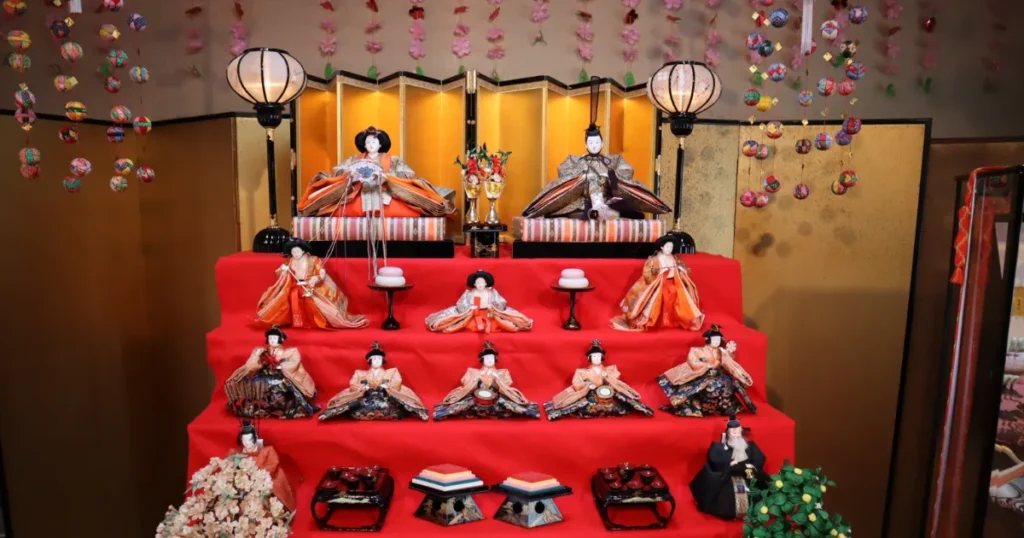
A full display, hinakazari, has seven tiers covered in red cloth, with the emperor and empress at the top and the court arranged below them. Most homes in Tokyo have neither the space nor the budget for that, so a pair of dolls or a three-tier set is now the usual choice.
Full seven-tier sets are what you will see in museums and exhibitions.

| Tier | Dolls and items | Role |
|---|---|---|
| 1 | Emperor and empress (obina and mebina) | The imperial couple, in front of a gold screen |
| 2 | Three court ladies | Serve sake to the couple |
| 3 | Five musicians | Drums, flute and a singer |
| 4 | Two ministers | Guards of the court, one young and one old |
| 5 | Three attendants | Servants, often showing three moods |
| 6 | Furniture and utensils | Chests, mirror stands and sewing boxes |
| 7 | Carriages and food boxes | An ox carriage and lacquered boxes |
In the Kanto region, including Tokyo, the emperor usually sits on the left as you face the display. In Kyoto and western Japan he often sits on the right. Both are correct.
Look for the small details, such as tiny tea sets, lacquer chests with working drawers and miniature food. Children usually find these more interesting than the faces.
When the Dolls Go Up and Come Down
Families put the dolls up from early or mid-February, and take them down soon after 3 March. A popular saying warns that leaving the dolls out too long will delay a daughter's marriage.
Few people take it seriously, but most still pack the dolls away within a week or two, on a dry day so the silk does not get damp.
Some regions celebrate a month later, in early April, following the old calendar, so you may still see displays in parts of the countryside in late March.
Hinamatsuri Food and Sweets
The festival has its own menu, and in late February food halls and sweet shops fill with it. Trying it is the easiest way for a visiting family to take part.
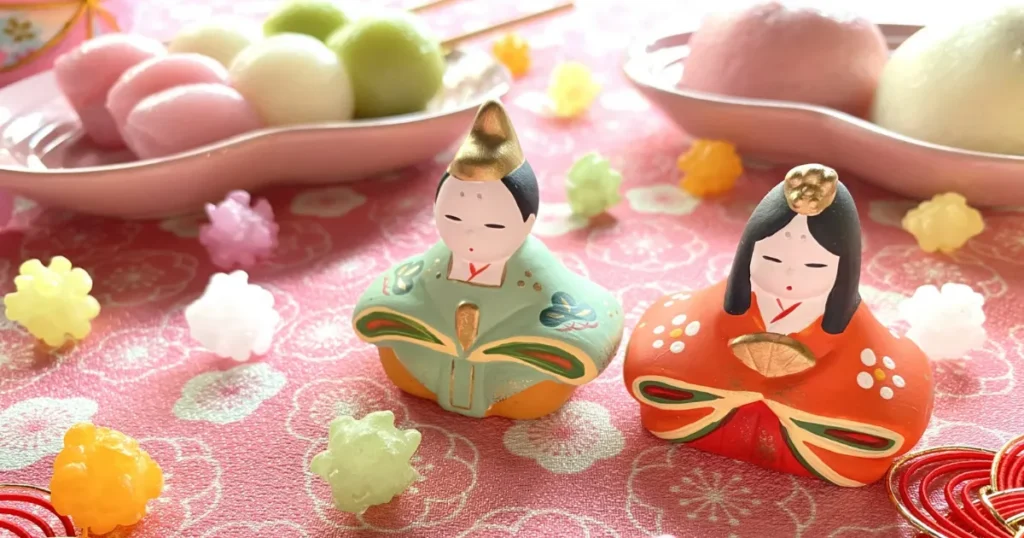
- Chirashizushi. Sushi rice scattered with toppings such as shrimp, egg, lotus root and peas. Shrimp is a wish for a long life, and lotus root, with its holes, for a clear view of the future.
- Hamaguri ushiojiru. Clear clam soup. The two shells of a clam fit only each other, a wish for a good marriage.
- Hishimochi. Diamond-shaped rice cakes in layers of pink, white and green, for peach blossom, snow and new grass.
- Hina-arare. Small, colourful puffed rice crackers, sweet in Tokyo and savoury in the Kansai region.
- Amazake and shirozake. Traditional sweet rice drinks. Amazake made from rice koji contains no alcohol, but amazake made from sake lees can contain a little, and shirozake is an alcoholic drink, so check the label before you give one to a child.
Department store food halls are the best place to find them, and the station malls are good too. See our guide to Gransta at Tokyo Station.
Where to See Hina Dolls in and near Tokyo in 2027
The surest places to see a full display in 2027 are two museums that have already published their dates, the Mitsui Memorial Museum in Tokyo and the Iwatsuki Ningyo Museum just north of the city. Town festivals near Tokyo publish their dates in January, so check them closer to the time.
| Where | 2027 dates | Getting there | Admission |
|---|---|---|---|
| Mitsui Memorial Museum, Nihonbashi | 11 Feb to 4 Apr 2027 | 1 min from Mitsukoshimae Station, Exit A7 | Adults from ¥1,200, junior high age and under free |
| Iwatsuki Ningyo Museum, Saitama | 23 Jan to 22 Mar 2027 | About 10 min walk from Iwatsuki Station | Adults ¥300, school children ¥100 |
| Katsuura Big Hinamatsuri, Chiba | February 2027, exact dates not yet published | JR Katsuura Station | Check when dates are out |
| Doll shops, Asakusabashi | All year, busiest in February | Asakusabashi Station | Free to browse |
Mitsui Memorial Museum, Nihonbashi
Each spring the museum shows the hina dolls and doll furniture collected by the women of the Mitsui family, one of Japan's great merchant houses. The 2027 show runs from 11 February to 4 April.
The museum opens 10:00 to 17:00, closes on Mondays, and is free for children of junior high school age and under. It is a short walk from Tokyo Station, so it fits into a morning in Nihonbashi.
Iwatsuki Ningyo Museum, Saitama
Iwatsuki has made dolls for centuries, and its city museum holds a yearly Hinamatsuri exhibition, running from 23 January to 22 March 2027 under a provisional title about the costumes of hina dolls. Admission is ¥300 for adults and ¥100 for primary and junior high pupils, though prices can change for special exhibitions. It closes on Mondays.
Katsuura Big Hinamatsuri, Chiba
The coastal town of Katsuura fills its streets, halls and the stone steps of Tomisaki Shrine with dolls donated from all over Japan. The festival committee has announced the 2027 edition for February and is already collecting dolls for it, but the exact dates had not been published as of October 2026.
It usually runs up to 3 March. It is a full day trip from Tokyo by JR limited express, so check the dates on the city's site in January.

Asakusabashi Doll Shops
The streets around Asakusabashi Station, one stop from Akihabara, are Tokyo's doll district. Long-established makers such as Kyugetsu and Yoshitoku have showrooms where you can see new hina sets without buying.
It is close to Asakusa, so it fits easily into a day there.
Visiting Japan in Early March with Kids
Early March is a good time for a family trip. It is quieter than the cherry blossom weeks, plum blossom is out in Tokyo's parks, and the Hinamatsuri decorations are everywhere.
It is still cool, so plan for layers.
- Weather. Tokyo's average daily high in March is about 14°C and the average low about 5°C. Mornings are cold. Afternoons can be mild.
- Pollen. March is the peak of cedar pollen season. If anyone in your family has hay fever, read our guide to hay fever and masks in Japan before you go.
- Museum manners. Do not touch the dolls or lean on the barriers, and check whether photos are allowed. Many exhibitions forbid flash or all photography.
- Kimono. A spring kimono suits photos beside the dolls. Our kimono rental guide explains how it works with children.
Hinamatsuri is a short stop rather than a full day, so it works best inside a wider plan. Our Tokyo private tour with kids can build a day around Asakusa and a seasonal stop like this, and the best time to visit Tokyo covers what else is on in March.
Earlier in the year, Setsubun on 3 February is the other seasonal custom families can join.
Frequently Asked Questions
- When is Hinamatsuri in 2027?
-
Hinamatsuri is always on 3 March. In 2027, that is a Wednesday. Dolls are usually displayed from February and put away soon after the day.
- Is Hinamatsuri a public holiday in Japan?
-
No. Schools, shops and offices are open as usual. It is celebrated at home with dolls and a special meal, and in museums, shops and hotels.
- What do people eat on Hinamatsuri?
-
Chirashizushi, clam soup, diamond-shaped hishimochi rice cakes and sweet hina-arare crackers. Some families drink amazake. Check the label, as some kinds contain alcohol.
- Why are hina dolls put away quickly?
-
A popular saying warns that leaving them out delays a daughter's marriage. Most families pack them away within a week or two, on a dry day.
- Where can I see hina dolls in Tokyo?
-
The Mitsui Memorial Museum in Nihonbashi shows its collection from 11 February to 4 April 2027. Department stores, hotels and the doll shops of Asakusabashi also display them.
- What is the difference between Hinamatsuri and Children's Day?
-
Hinamatsuri on 3 March is for girls and is not a holiday. Children's Day on 5 May, once Boys' Day, is a public holiday with carp streamers and samurai helmets.
Sources
https://www.mitsui-museum.jp/exhibition/schedule.html
https://www.mitsui-museum.jp/guide/index.html
https://www.mitsui-museum.jp/guide/access.html
https://ningyo-muse.jp/modules/exhibition/index.php?action=PageView&page_id=62
https://ningyo-muse.jp/modules/info/index.php?action=PageView&page_id=1
https://www.city.katsuura.lg.jp/site/hinamatsuri/11430.html
https://www.data.jma.go.jp/stats/etrn/view/nml_sfc_ym.php?prec_no=44&block_no=47662
Plan a Private Day with a Local

Every tour is private, for your group only, and planned with you before you arrive. From US$550 per group for a day on foot in Tokyo or Yokohama, or from US$890 for a day trip by train to Kamakura, Hakone or Mt. Fuji. Travelling with children? See our Tokyo private tour with kids.
Free Consultation
Japan Trails Newsletter
Free Newsletter Sign‑Up
Subscribe to our newsletter and receive a handpicked list of restaurants that Japanese locals go to.
-
 Kanda Myojin Shrine, Tokyo: A Visitor's Guide
-
 Imperial Palace Tokyo: A Visitor Guide to the East Gardens, Nijubashi and the Palace Tour
You might also like
-
 Hay Fever in Japan: Pollen Season, Masks and Tips for Families
-
 Yushima Seido and Hijiri Bridge: A Walk Through Ochanomizu
-
Imperial Palace Tokyo: A Visitor Guide to the East Gardens, Nijubashi and the Palace Tour
-
Kanda Myojin Shrine, Tokyo: A Visitor's Guide
-
 Setsubun in Japan: Bean Throwing, Ehomaki and Where to See It
-
 Naritasan Shinshoji Temple: A Visitor's Guide with the Omotesando
-
 Sumo Wrestling in Japan: Tournament Dates, Tickets and Watching with Kids