National Museum of Western Art Tokyo Complete Guide
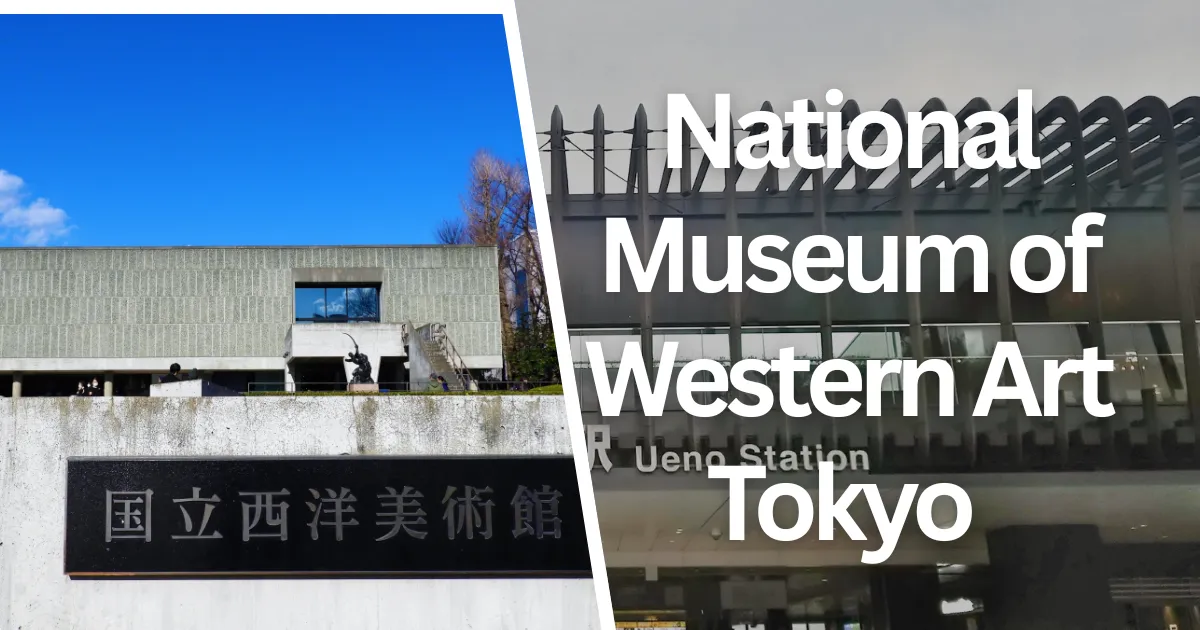
The National Museum of Western Art Tokyo stands as Japan’s premier institution dedicated exclusively to Western art.
This architectural marvel designed by renowned Swiss-French architect Le Corbusier was designated a UNESCO World Heritage Site in 2016.
The museum houses the legendary Matsukata Collection featuring works by Monet, Renoir, Van Gogh, Rodin and other European masters.
National Museum of Western Art History
Matsukata Collection history begins with Japanese industrialist Kojiro Matsukata who amassed approximately 10,000 artworks between 1916 and 1927.
Following World War II diplomatic negotiations, France agreed to return 375 artworks to Japan in 1959 on the condition that they be housed in a museum designed by a French architect.
The museum opened on June 10, 1959 as a symbol of renewed friendship between Japan and France.
Kojiro Matsukata’s Vision: Building Japan’s First Western Art Museum (1916-1927)
Kojiro Matsukata leveraged his fortune as president of Kawasaki Dockyard to pursue an ambitious art collecting mission.
His close friendship with British artist Frank Brangwyn provided expert guidance in acquiring masterworks across Europe.
Between 1916 and 1927, Matsukata accumulated approximately 10,000 items including paintings by Monet, Gauguin, Van Gogh, Rodin sculptures, and ukiyo-e prints.
Matsukata envisioned the “Sheer Pleasure Fine Arts Pavilion” where Japanese artists could study authentic Western art without traveling abroad.
He secured a building site in central Tokyo and commissioned Frank Brangwyn to design the museum.
When visiting Monet’s Giverny studio, Matsukata convinced the artist to sell 18 paintings by explaining they would educate underprivileged Japanese art students.
The Turbulent Journey: War, Confiscation, and Diplomatic Negotiations (1927-1959)
The 1927 Showa Financial Crisis devastated Kawasaki Dockyard’s finances and shattered Matsukata’s museum dreams.
Artworks already delivered to Japan were sold to creditors. A catastrophic 1939 warehouse fire at the Pantechnicon in London consumed numerous irreplaceable masterpieces.
World War II brought further calamity when France confiscated the Paris-stored collection as “enemy property.”
After the 1951 San Francisco Peace Treaty, Prime Minister Shigeru Yoshida initiated diplomatic efforts to reclaim the artworks.
France agreed to return 375 pieces but retained 17 valuable works including Van Gogh’s “Bedroom in Arles.”
The negotiated settlement included a crucial condition: Japan must construct a museum designed by a French architect.
This requirement led directly to Le Corbusier’s commission. In April 1959, the recovered artworks finally arrived at Yokohama port, just two months before the grand opening.
UNESCO World Heritage Recognition and Le Corbusier’s Legacy (2016)
In July 2016, UNESCO inscribed 17 Le Corbusier buildings across seven countries as World Heritage Sites.
The NMWA main building gained recognition for embodying Le Corbusier’s revolutionary architectural principles.
This honor confirmed the museum’s global significance beyond its art collection.
Following UNESCO designation, ICOMOS identified discrepancies between the forecourt’s current state and Le Corbusier’s original design.
Between October 2020 and April 2022, the museum undertook comprehensive forecourt restoration during a major renovation closure.
The restoration minimized vegetation, repositioned Rodin sculptures, and meticulously restored floor joints following Le Corbusier’s Modulor grid system.
Le Corbusier Museum Tokyo
Le Corbusier architecture in Tokyo represents his groundbreaking “Museum of Unlimited Growth” concept, designed to expand organically from a central core through spiral development.
The building embodies Le Corbusier’s Five Points of Architecture including pilotis, free plan, free facade, horizontal windows, and roof garden.
Completed in March 1959 under supervision of three Japanese apprentices, the structure showcases Brutalist concrete aesthetics combined with Modulor proportional system.
The “Museum of Unlimited Growth” Concept: Revolutionary Design
Le Corbusier conceived the museum using a 6m × 6m square grid system that could theoretically expand infinitely outward in a spiral pattern.
The central 19th Century Hall features a double-height space flooded with natural light from a pyramidal skylight.
Exhibition galleries spiral around this central void, allowing visitors to progress through the collection in an organic, continuous flow.
The “unlimited growth” concept appeared in Le Corbusier’s earlier projects in Chandigarh and Ahmedabad, India.
Although the museum has not expanded into the full spiral originally envisioned, the existing structure clearly demonstrates how future wings could be added.
Four lighting troughs originally illuminated the paintings gallery with carefully controlled daylight, though these have been replaced with artificial lighting for conservation purposes.
Brutalist Beauty: Materials and Structural Innovation
The museum’s exterior employs precast concrete panels with exposed aggregate finish, exemplifying Le Corbusier’s Brutalist aesthetic.
These panels sit on U-shaped frames supported by the inner wall structure.
The raw concrete surface creates a powerful contrast with the refined artworks housed within.
Pilotis (concrete columns) elevate the main gallery floor to first-floor level, creating an open ground floor.
The promenade ramp on the north side provides dramatic ascent from the entrance hall to the paintings gallery.
This ramp offers changing perspectives of Rodin’s sculptures while fulfilling Le Corbusier’s principle of architectural promenade.
Le Corbusier applied his Modulor proportional system to every element of the building.
The Modulor, based on human body proportions and the Golden Ratio, creates harmonious dimensions throughout the museum.
This mathematical approach ensures the building relates to human scale at every level.
Forecourt Restoration: Preserving Le Corbusier’s Original Vision (2020-2022)
The 2020-2022 restoration project addressed decades of alterations that had compromised Le Corbusier’s original forecourt design.
Vegetation had overgrown the space, obscuring the intended openness and sculpture placement.
The restoration team meticulously researched historical photographs to understand the architect’s intentions.
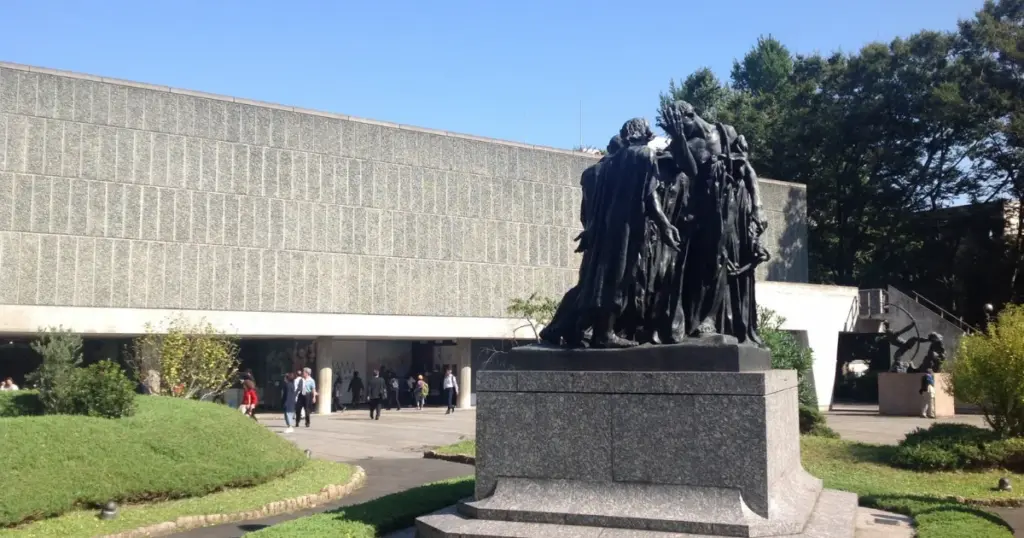
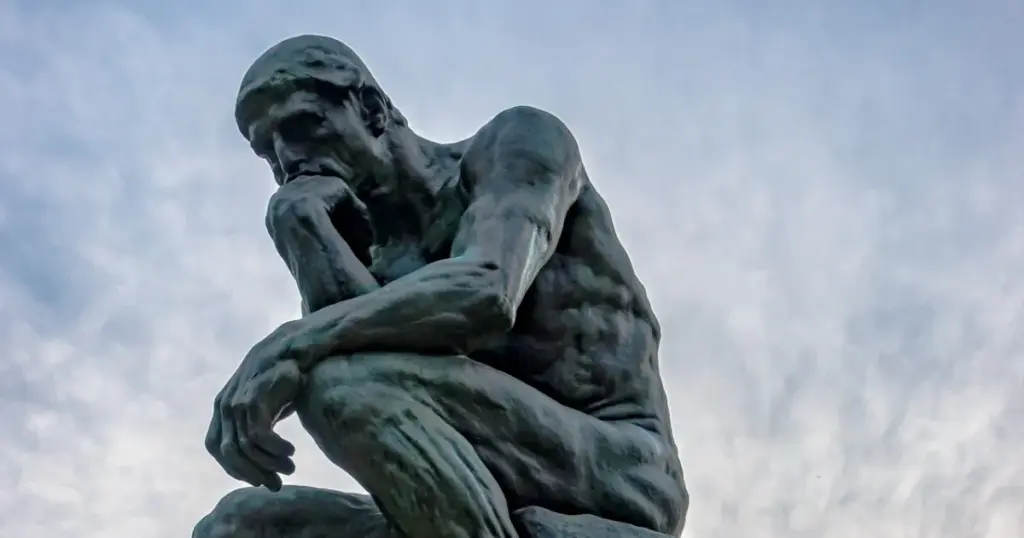
Rodin’s iconic sculptures “The Thinker” and “The Burghers of Calais” were repositioned to their original 1959 locations.
The forecourt flooring joints, laid out according to Le Corbusier’s Modulor proportions, were restored in precise detail.
The restoration removed unnecessary plantings and returned the forecourt to its original minimalist character.
Matsukata Collection Masterpieces
Impressionist paintings Tokyo collection features exceptional works by Claude Monet including Water Lilies series, Pierre-Auguste Renoir, Edgar Degas, and Camille Pissarro.
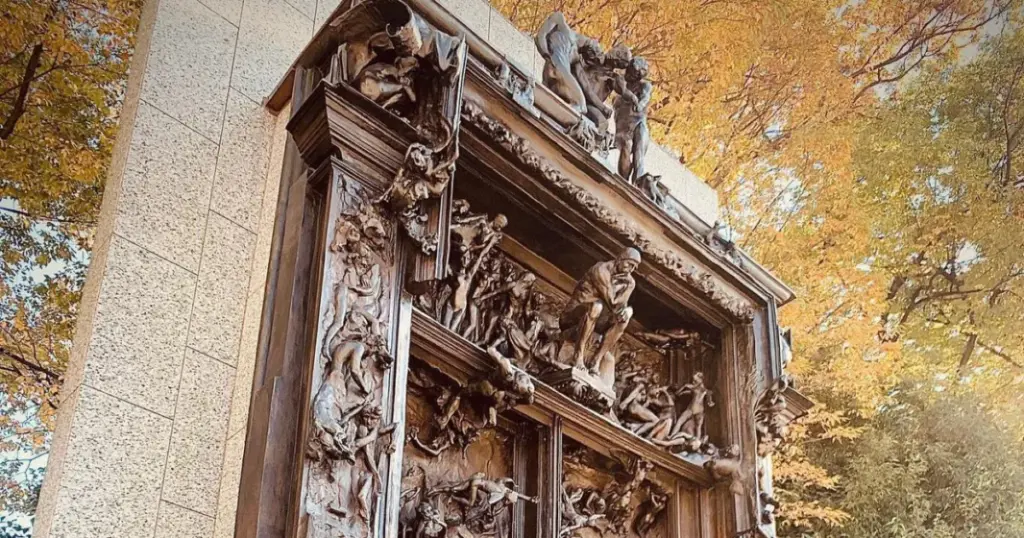
Auguste Rodin sculptures dominate the museum’s forecourt with iconic works like The Thinker, The Gates of Hell, and The Burghers of Calais cast from original molds.
Post-Impressionist works by Vincent van Gogh, Paul Gauguin, and Henri de Toulouse-Lautrec complement the collection alongside Renaissance and Baroque masterpieces.
Claude Monet’s Masterworks: Direct from Giverny Studio
Matsukata’s personal relationship with Claude Monet resulted in acquiring 18 paintings directly from the artist’s Giverny studio.
Matsukata explained his altruistic mission to provide Japanese art students access to Western masterworks.
Monet, moved by this educational vision, agreed to sell works he had intended to keep forever.
The collection includes multiple works from Monet’s Water Lilies series, showcasing the artist’s late-period obsession with light and reflection.
In 2016, researchers rediscovered “Water Lilies, Reflections of Weeping Willows” in Paris after decades of unknown whereabouts.
NMWA’s Monet collection represents one of the finest assemblages of the artist’s work outside France.
Rodin’s Monumental Sculptures: The Gates of Hell and Beyond
Auguste Rodin’s sculptures provide the museum’s most dramatic first impression, greeting visitors in the forecourt before they enter.
“The Thinker” occupies a prominent position, cast from the same original molds as the version in Paris’s Rodin Museum.
“The Gates of Hell” towers over the forecourt, its intricate surface teeming with tortured figures from Dante’s Inferno.
“The Burghers of Calais” commemorates medieval heroes who sacrificed themselves to save their city during the Hundred Years’ War.
The sculpture demonstrates Rodin’s psychological insight and rejection of traditional heroic poses.
Matsukata acquired these monumental bronzes directly from Rodin or through authorized foundries using the master’s original molds.
Old Masters to Modern: Renaissance Through 20th Century Collection
While Impressionism dominates the collection, NMWA also houses significant Old Master paintings from the Renaissance and Baroque periods.
Works by Veronese from the Renaissance and Rubens and Fragonard from the Baroque era provide art historical context for understanding how European painting evolved.
These earlier works demonstrate the technical traditions that Impressionists would later revolutionize.
The Post-Impressionist section features emotionally charged works by Van Gogh, Gauguin, and Toulouse-Lautrec.
These artists moved beyond Impressionism’s objective observation toward more personal, symbolic approaches.
The collection extends into early 20th-century modernism with works by Picasso and Jackson Pollock.
| Period | Representative Artists | Characteristics |
|---|---|---|
| Renaissance | Paolo Veronese | Provides historical context for later movements |
| Baroque | Peter Paul Rubens, Jean-Honoré Fragonard | Demonstrates evolution of European painting traditions |
| Impressionism | Monet, Renoir, Degas, Pissarro | Forms the core strength of the collection |
| Post-Impressionism | Van Gogh, Gauguin, Toulouse-Lautrec | Showcases personal expression and symbolism |
| Modern | Picasso, Pollock | Extends into early 20th-century developments |
FAQ About National Museum of Western Art Tokyo
Essential visitor questions focus on admission fees, access routes, operating hours, and photography policies.
These practical details help international travelers plan their museum visit efficiently.
The following FAQ addresses the most important logistics for first-time visitors.
- What are the admission fees?
-
Category Admission Fee Adults ¥500 University Students ¥250 High School & Under 18 Free Seniors 65+ Free Disabled + 1 Attendant Free - What are the opening hours?
-
Day Hours Tuesday – Thursday, Sunday 9:30 – 17:30 Friday & Saturday 9:30 – 20:00 Closed Mondays (or Tuesday if Monday is a holiday) Year-end Closure December 28 – January 1 Last admission is 30 minutes before closing time.
- How do I get to the museum from major Tokyo locations?
-
Departure Point Transportation Time Fare Details JR Ueno Station Walk 1 min Free Take Park Exit (Koen-guchi) Narita Airport Narita Express 60-70 min ~¥3,000 Direct to Ueno Station Narita Airport Keisei Skyliner 45 min ¥2,470 To Keisei-Ueno (7 min walk) Tokyo Station JR Yamanote Line 7 min ¥140 To Ueno Station Shibuya Tokyo Metro Ginza Line 25 min ¥210 Direct to Ueno Station Shinjuku JR Chuo Line + Yamanote Line 18 min ¥210 To Ueno Station The museum is visible immediately upon entering Ueno Park from Ueno Station Park Exit.
- Can I take photos inside the museum?
-
Yes, photography is generally permitted in permanent collection galleries without flash or tripods.
However, special exhibitions often prohibit photography due to loan agreements with other institutions.
The Rodin sculptures in the outdoor forecourt can be freely photographed from any angle.
Conclusion
National Museum of Western Art Tokyo conclusion emphasizes the institution’s dual significance as both an architectural masterpiece and world-class art repository.
The museum’s unique position bridging Japanese and Western cultures through Kojiro Matsukata’s visionary collecting makes it irreplaceable.
For international visitors to Tokyo, NMWA offers an unparalleled opportunity to experience European artistic heritage within a UNESCO-designated modernist architectural icon.
National Museum of Western Art Tokyo
Adress
7 – 7 Uenokoen, Taito City, Tokyo
Nearest station
Ueno Station (Shinkansen / Keihin-Tohoku / Yamanote / Utsunomiya / Ueno-Tokyo / Takasaki / Jyoban / Ginza)
Explore Tokyo with a Local!!

We offer tailored private tours designed for small groups. Prices start from 200 USD per person, and every itinerary can be fully customized.