
Quick answer
- Tokyo is one of the easiest big cities to visit with children: it is safe, clean, and almost every station has lifts and baby rooms.
- Plan 4 to 5 days for Tokyo itself, plus a day trip to Mt. Fuji or Hakone if you can.
- The places children enjoy most are teamLab, the Pokémon Center, Ueno Zoo, Tokyo Skytree, Senso-ji in Asakusa and Tokyo Disney. Several need tickets booked weeks ahead.
- On trains, under-6s ride free, but only two per paying passenger; the third pays the child fare.
- Two traps: teamLab Borderless does not allow strollers, and SHIBUYA SKY’s rooftop only allows its own rental strollers.
Is Tokyo Good for Kids?
Yes. Tokyo is safe enough that Japanese children ride the train to school on their own, the streets are clean, and stations, department stores and museums almost all have lifts, toilets with baby seats and nursing rooms. The hard parts are the size of the city, the crowds at peak times and the number of stairs in older stations.
I plan private days in Tokyo for families from overseas, and the trips that go best are the ones that do less: two or three places a day, close together, with a long lunch and room for a nap.
How many days? Four to five days covers Tokyo at a child’s pace. Add a sixth for Tokyo Disney, and a seventh for a day trip to Mt. Fuji or Hakone.
If you would rather not work out trains, tickets and nap times yourself, that is exactly what our private Tokyo tour with kids is for.
Best Things to Do in Tokyo with Kids at a Glance
Prices are for October 2026 and many are date-based, so check before you go.
| Place | Best for | Child price | Book ahead? | Stroller |
|---|---|---|---|---|
| teamLab Planets | 4+ | 4–12: ¥1,500; 3 and under free | Yes, no tickets at the door | Leave it; front carriers OK |
| teamLab Borderless | 4+ | 4–12: ¥1,500; 3 and under free | Yes | Not allowed; no nursing room |
| Ghibli Museum | 4+ fans | 4–6: ¥100; 7–12: ¥400 | Yes, on the 10th of the month before | Leave it at the entrance |
| Pokémon Center Shibuya | All ages | Free to enter | No | Crowded; carrier is easier |
| Ueno Zoo | 0–8 | Primary age and under free | No | Yes; rental ¥500 |
| Tokyo Skytree | All ages | 6–14: from ¥900; 5 and under free | Recommended | Yes |
| SHIBUYA SKY | 6+ | Primary school ¥1,200, at the counter only | Yes for adults | Rooftop: venue strollers only |
| Senso-ji, Asakusa | All ages | Free | No | Yes, with some steps |
| Tokyo Disney | All ages | 4–11: from ¥5,300; 3 and under free | Yes | Yes; rental available |
Hands-On Digital Art, Science and Museums
teamLab is the one most children remember; the Ghibli Museum is for fans who can book a month ahead; the science museums are the best rainy-day choice.
teamLab Planets and teamLab Borderless
These are the places children talk about afterwards. Planets in Toyosu is walked barefoot, through rooms of water that reach an adult’s knees, so pack shorts or use the free rental ones. Strollers are left at the entrance, but you can carry a baby in a front carrier. Borderless at Azabudai Hills is a maze of rooms with no fixed route. It does not allow strollers and has no nursing room, so it suits children who can walk on their own.
Both sell timed tickets online only, and weekends and school holidays sell out.
Ghibli Museum
Tickets go on sale at 10:00 Japan time on the 10th of each month, for the following month, and they go quickly. There is nothing for sale at the museum. Allow half a day for Mitaka and the walk through Inokashira Park.
Miraikan and the National Museum of Nature and Science
Miraikan in Odaiba is Tokyo’s science museum for the future: robots, space and a giant globe. In Ueno, the National Museum of Nature and Science has dinosaurs and a hands-on gallery for small children.
Theme Parks and Character Worlds
Tokyo Disney is a full day of its own; the character shops in Shibuya and Tokyo Station fit into an hour between other plans.
Tokyo Disneyland and DisneySea
A full day each. Tickets are date-based and sold online; children 3 and under are free. DisneySea suits older children; Disneyland is easier with toddlers.
Pokémon Center, Nintendo TOKYO and Tokyo Character Street
The Pokémon Center Shibuya and Nintendo TOKYO are on the 6th floor of Shibuya PARCO, free to enter and busy on weekends. Tokyo Character Street under Tokyo Station has around 30 character shops in one corridor, including the Jump Shop, good for a rainy hour.
When I take families to the Pokémon Center, we go right at opening. An hour later the queue for the popular goods and the photo spots is a different story.
Mihiro Ono, founder of Japan Trails
Sanrio Puroland and KidZania
Sanrio Puroland in Tama is indoors and reservation-only, which makes it a good rainy-day trip for younger children. At KidZania, children aged 3 to 15 try real jobs in a city built to their size; parents watch from outside.
Parks, Zoos and Free Places to Run Around
Ueno Zoo is free for children of primary-school age and under, closes on Mondays, and rents strollers for ¥500 a day (cash only). Ueno Park around it has the museums, a pond with swan boats and plenty of space. For the whole area, see our Ueno guide.
Yoyogi Park next to Meiji Jingu is where Tokyo families go on Sundays. Further out, Showa Memorial Park in Tachikawa has one of the biggest playgrounds in the city, and Mt. Takao is an easy hill with a cable car for a first mountain.
Temples, Shrines and Old Tokyo
Children usually enjoy the doing rather than the history: waving incense smoke over themselves at Senso-ji, drawing an omikuji fortune for 100 yen, washing their hands at the shrine fountain, and bowing twice and clapping twice at a Shinto shrine. Asakusa is also where families rent kimono for the morning.
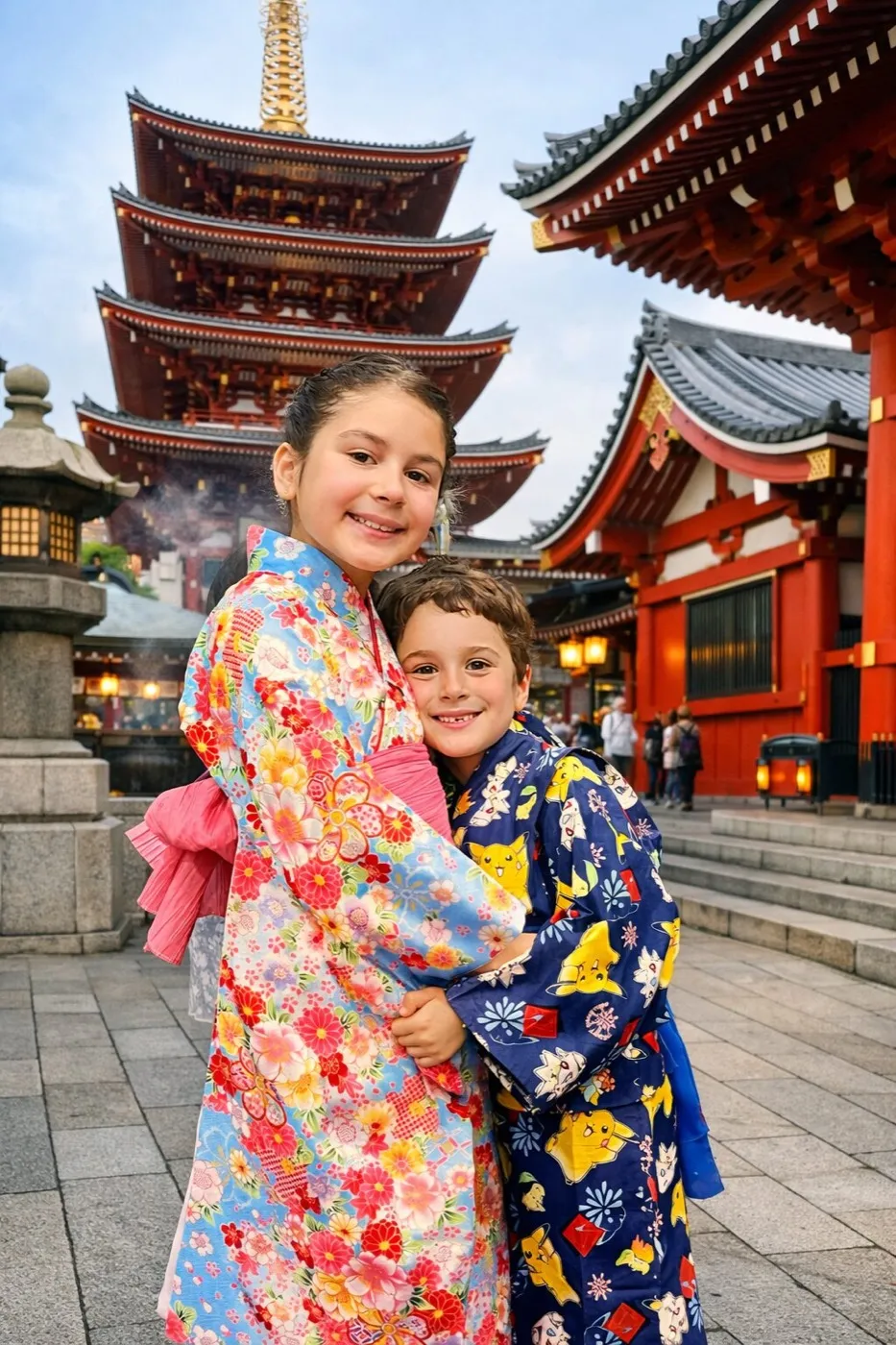
Our classic first day starts here, and you can see the whole route, with photos from our own tours, on our Tokyo private tour with kids page.
Tokyo Views from Above
Tokyo Skytree is the tallest, and children 5 and under are free. SHIBUYA SKY is the most exciting, an open-air rooftop over the Shibuya crossing, but bags, hats and your own stroller are not allowed on the roof, and child tickets are sold at the counter only. The Tokyo Metropolitan Government Building in Shinjuku has a free observation deck, which is the easiest with small children.
Best Things to Do in Tokyo by Age
The right places change more with age than with interests. Here is what works, and what to skip, at each stage.
| Age | What works | What to skip |
|---|---|---|
| 0–2 | Ueno Zoo, parks, Skytree, department store rooftops | teamLab Borderless, long museum days |
| 3–6 | teamLab Planets, Pokémon Center, Sanrio Puroland, KidZania | Tea ceremony longer than 30 minutes |
| 7–12 | Ghibli Museum, Disney, Miraikan, a food sample workshop | Too many shopping streets |
| Teens | Akihabara, Harajuku, SHIBUYA SKY, sumo | Anything with a long queue and no payoff |
On my tours, the children’s favourites are the anime places: the Pokémon Center and the Jump Shop. What falls flat is anything too niche, or a place with nothing to look at. A temple works when there is something to do there; a quiet garden with a long history usually does not.
Mihiro Ono, founder of Japan Trails
Rainy-Day and Hot-Day Plans
June brings the rainy season and July to September is often above 35°C. Both are when the indoor places earn their keep: teamLab, Miraikan, the Pokémon Center, Tokyo Character Street, Sanrio Puroland and department store food halls. On our tours, rain means swapping open-air stops for markets, covered temples and cafés rather than cancelling.
When the forecast says rain or heat, I rebuild the day around indoor stops and add more breaks than usual: a café, a department store, somewhere with air conditioning every hour or so. Children tire faster in the heat than they say they do.
Mihiro Ono, founder of Japan Trails
Getting Around Tokyo with Kids
Trains are the fastest way around Tokyo with children; the things to know are the child fare rule, which exits have lifts, and that taxis rarely carry child seats.
Child fares on trains
Tokyo Metro and JR use the same rule. Children aged 6 to 11 pay half fare. Children aged 1 to 5 ride free, but each adult or paying child can take only two of them free; the third pays the child fare. Babies under 1 are always free. Children’s IC cards (Suica or PASMO) charge the child fare automatically; buy them at a station office with a passport.
Strollers and stations
Every major station has lifts, but not every exit does, and the lift is often at the far end of the platform. Use the lift signs rather than the exit number, and fold the stroller on crowded trains at rush hour (roughly 7:30–9:30 and 17:30–19:30).
In my experience JR stations are rarely a problem with a stroller. Some Tokyo Metro and Toei subway stations have fewer escalators and lifts, so on those lines I check the exit with a lift before the day rather than looking for it on the platform.
Mihiro Ono, founder of Japan Trails
Taxis and child seats
Japanese law requires a child seat for children under 6 in private cars, but taxis are exempt, so most do not carry one. If you want seats, book a car in advance. On our private-car days, the seats are fitted before we pick you up.
Strollers, Nursing Rooms, Naps and Food Allergies
Nursing rooms. Tokyo has over 1,600 registered “Akachan Furatto” baby rooms where you can feed and change, plus baby rooms in every department store and most stations.
Naps. Plan the day in two halves with lunch in the middle, and put the train ride or the car where the nap usually falls.
Food allergies. Japanese packaged food must label major allergens, but restaurants often cannot tell you what is in a dish. Book ahead and tell the restaurant in advance, in Japanese. Conveyor-belt sushi is the easiest sit-down meal with children; our sushi guide explains how it works.
I ask about allergies and food restrictions before the day, and when we book a restaurant I send the request in advance. For one family at a wagyu yakiniku restaurant, I arranged a separate menu ahead of time for the member who could not eat meat, so nobody had to sort it out at the table.
Mihiro Ono, founder of Japan Trails
Our private tour with kids checks allergies with the restaurant before the day, and your guide explains them again at the table.
Sample 3-Day Tokyo Itinerary with Kids
Three days covers old Tokyo, the digital art and the Shibuya side at a child’s pace.
| Day | Morning | Afternoon |
|---|---|---|
| 1 | Asakusa, Senso-ji, a tea ceremony | Imperial Palace East Gardens, Tokyo Tower |
| 2 | teamLab Planets (book ahead) | Odaiba, Miraikan |
| 3 | Meiji Jingu, Yoyogi Park | Pokémon Center Shibuya, SHIBUYA SKY at sunset |
Add Ueno Zoo on a weekday morning, Tokyo Disney on a separate day, and a day trip to Mt. Fuji if the weather is clear. For longer trips, see our Tokyo itinerary for 3, 4 or 5 days, our guide to day trips from Tokyo, and the best time to visit Tokyo.
Frequently Asked Questions
Is Tokyo worth visiting with kids?
Yes. It is safe, clean and easy to get around, and it has a rare mix of high-tech museums, theme parks and old temples within one train network.
How many days do you need in Tokyo with kids?
Four to five days at a child’s pace, plus one for Disney and one for a day trip to Mt. Fuji or Hakone.
Is Tokyo good for toddlers?
Yes, with planning. Choose places with space and lifts, such as Ueno Zoo, parks and Skytree, avoid teamLab Borderless with a stroller, and plan around the nap.
Do kids ride trains free in Tokyo?
Under-6s ride free, two per paying passenger. Children aged 6 to 11 pay half fare, and babies under 1 are always free.
What is a good day trip from Tokyo with kids?
Mt. Fuji and Lake Kawaguchi, or Hakone with its pirate ship and ropeway. Both work as a day by train or by private car with child seats.
Can we hire a private guide in Tokyo for a family?
Yes. Our private days start at US$550 per group, with no child price and infants free. The day is planned around your children before you arrive.
Sources
- https://www.tokyometro.jp/lang_en/ticket/guide/age/index.html
- https://www.jreast.co.jp/en/multi/faq/
- https://www.teamlab.art/e/planets/
- https://www.teamlab.art/e/tokyo/
- https://www.tokyo-zoo.net/ueno/visitor-info/tickets/index.html
- https://en.tokyo-skytree.jp/ticket/
- https://www.ghibli-museum.jp/en/tickets/
- https://www.shibuya-scramble-square.com/sky/faq/
- https://www.tokyodisneyresort.jp/en/ticket/index.html
- https://www.fukushi.metro.tokyo.lg.jp/kodomo/kosodate/akachanflat.html