Meiji Jingu: A Family Guide to Tokyo's Forest Shrine

Quick answer
- Meiji Jingu is a Shinto shrine in Shibuya, dedicated in 1920 to Emperor Meiji and Empress Shoken, inside a 70-hectare forest next to Harajuku Station.
- Entry is free, every day.
- Allow about 1 hour for the shrine, or 2 hours with the Inner Garden (¥500) and the Meiji Jingu Museum (¥1,000, closed Thursdays).
What Is Meiji Jingu?
Meiji Jingu is Tokyo's best-known Shinto shrine, dedicated in 1920 to Emperor Meiji and Empress Shoken, the couple who led Japan into the modern age. It is not a temple.
There are no Buddha statues here. The kami (deities) enshrined are the Emperor and Empress themselves, and the shrine is an active place of worship, where people come to pray, mark births and coming-of-age, and hold weddings.
The shrine sits in a forest of about 70 hectares, between Harajuku and Yoyogi. The forest looks ancient, but it was planted by hand. Around 110,000 volunteers planted trees donated from all over Japan, and the shrine says it has grown with no human intervention since.
Today it has 234 varieties of trees. The shrine buildings were lost in the air raids of 1945 and rebuilt after the war.

For families, Meiji Jingu is the calm half of a Shibuya day. It is free, it is green, and children get to do things here (wash their hands at the water basin, bow and clap, draw a fortune) rather than just look.
Opening Hours and Admission
Meiji Jingu is open every day of the year and entry to the shrine grounds is free. The gates open at sunrise and close at sunset, so the times change each month.
Some buildings inside, such as the amulet office and the garden, keep shorter hours, mainly 9:00 am to 4:00 pm.
| Month | Opens | Closes |
|---|---|---|
| January | 6:40 am | 4:20 pm |
| February | 6:20 am | 4:50 pm |
| March | 5:40 am | 5:20 pm |
| April | 5:10 am | 5:50 pm |
| May | 5:00 am | 6:10 pm |
| June | 5:00 am | 6:30 pm |
| July | 5:00 am | 6:20 pm |
| August | 5:00 am | 6:00 pm |
| September | 5:20 am | 5:20 pm |
| October | 5:40 am | 4:40 pm |
| November | 6:10 am | 4:10 pm |
| December | 6:40 am | 4:00 pm |
Two places inside charge a fee.
- Meiji Jingu Gyoen (Inner Garden). ¥500 as a maintenance contribution.
- Meiji Jingu Museum. Adults ¥1,000, high school age and under ¥900, children below primary school age free. Open 10:00 am to 4:30 pm, last entry 30 minutes before closing, closed on Thursdays (open if Thursday is a public holiday) and between exhibitions.
Note that the amulet office, the Kaguraden and the goshuin counter do not take credit cards, so bring some coins and small notes.
How to Get to Meiji Jingu
The main entrance is a short walk from JR Harajuku Station on the Yamanote Line. Meiji-jingumae Station on the Tokyo Metro Chiyoda and Fukutoshin lines is also close by.
There are also entrances on the north side, nearer Yoyogi and Sangubashi stations, which are quieter.
From any entrance, the shrine says it takes at least ten more minutes on foot to reach the main shrine buildings. Bicycles and motorbikes are not allowed inside.
There is parking for them at the entrance. Wheelchairs are available at the entrance of the grounds. There is no luggage storage, so do not come straight from the hotel with suitcases.
Walking the Approach Past Torii Gates and Barrels
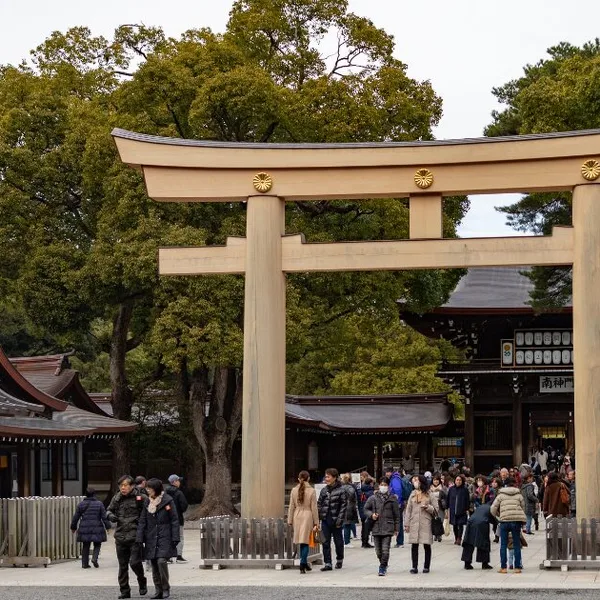
The walk through the forest is part of the visit in its own right. The wide gravel approach from Harajuku passes under a series of large wooden torii gates.
A torii marks the line between the everyday world and the sacred area, and many Japanese visitors stop and bow once before walking through.
About halfway along, you pass two walls of barrels facing each other. On one side are barrels of sake offered by brewers from across Japan.
On the other are barrels of wine from Burgundy, presented by French wineries in 2006 in memory of Emperor Meiji's fondness for French wine and as a sign of friendship between France and Japan. Most visitors stop here for a photo.

Keep to the sides of the path where you can. Gravel is tiring for small legs and slow for strollers, so this is a good stretch for a front carrier or a ride on a parent's shoulders.
How to Pray at Meiji Jingu
Visitors of any faith are welcome to pray here, and the steps are simple. The shrine asks you to purify yourself with water first, at the temizuya (water basin) near the main sanctuary.
- Rinse your hands with the water from the ladle.
- Pour water into your cupped palm and rinse your mouth (do not drink from the ladle).
- Rinse your hands again.
Then, in front of the main hall, follow these steps.
- If you wish, put a coin in the offering box.
- Bow twice.
- Clap your hands twice.
- Bow once more.
Children like having something to do with their hands here. Keep voices low near the main hall, and do not take photos in front of it while people are praying.
Omikuji, Ema and Amulets
Meiji Jingu's omikuji (fortune slip) is different from the ones at most temples and shrines. Instead of "great luck" or "bad luck", you draw one of 30 waka poems written by Emperor Meiji and Empress Shoken, with an English translation. It costs ¥100.
Ema are wooden plaques for writing a wish or a thank-you. They cost ¥500 (¥1,000 at New Year), and you hang them on the camphor tree in front of the main shrine.
Writing one is a good way for children to spend ten minutes while the adults look around.

Amulets (omamori) for safe travel, health and study are sold at the amulet office near the main hall. The shrine asks visitors not to photograph the amulet office.
You can also collect a goshuin, a handwritten shrine seal, at its own counter.
Inner Garden and Meiji Jingu Museum
Both charge a fee, so add them only if you have time after the shrine itself. With young children, the free grounds are usually enough.
Meiji Jingu Gyoen (Inner Garden)
The Inner Garden was imperial land before the shrine was built, and Emperor Meiji had it laid out partly for Empress Shoken. It has a pond, a tea house, Kiyomasa's Well and, in June, irises.
Azaleas bloom in spring and the maples turn in late autumn. The fee is ¥500, and like other facilities inside it keeps daytime hours. It is quieter than the rest of the grounds, but paths are narrower, so it suits children who can walk on their own.
Meiji Jingu Museum
The museum, opened in 2019 in a low wooden building near the main hall, shows objects used by the Emperor and Empress, including formal clothing and items used at state occasions. The visit is short and quiet, which suits older children and adults.
Children below primary school age enter free. Check the Thursday closing before you plan around it.

How Long to Spend at Meiji Jingu with Kids
The shrine's own answer is about 1 hour for the shrine, and about 2 hours if you add the Inner Garden and the Museum. With small children, I plan 1 to 1.5 hours, which covers 10 to 15 minutes each way along the approach, time at the water basin and the main hall, a fortune slip or an ema, and a rest.
Food and drink are only allowed in designated areas, so do not plan a picnic on the approach. Forest Terrace, inside the grounds, has a restaurant and souvenirs, and there are toilets at several points in the grounds, shown on the official precinct map.
Yoyogi Park next door is where Tokyo families go to run around and eat outside, so it makes a natural next stop.
Best Time to Visit Meiji Jingu
Early morning on a weekday is the quietest time, and in summer it is also the coolest, because the forest shades most of the approach. Remember that the gates close at sunset, so a late-afternoon visit in November or December has to finish by around 4:00 pm.
- New Year (1 to 3 January). Hatsumode, the first shrine visit of the year, brings millions of people. Expect long queues and crowd control. Avoid it with small children.
- June. The irises flower in the Inner Garden, but it is also the rainy season.
- 3 November. The shrine holds its annual festival on Emperor Meiji's birthday.
- Weekends. You may see a Shinto wedding procession crossing the courtyard. Watch quietly from the side and do not block their path for photos.
Meiji Jingu Etiquette for Families
Meiji Jingu is a working place of worship, and visitors are asked to behave as guests, as follows.
- Speak quietly, especially near the main hall.
- Eat and drink only in the designated areas.
- Do not sit or climb on fences, lanterns or gates, and do not take stones or leaves home from the grounds.
- Photos are fine almost everywhere, except in front of the main shrine during worship and at the amulet office.
- Bow once at the torii if you wish, and keep to the side of the path.
None of this is hard with children. It helps to explain before you arrive that this is a place where people come to pray, the way they would at a church, so the quiet makes sense to them.
Combining Meiji Jingu with Harajuku and Shibuya
Meiji Jingu is the easiest shrine in Tokyo to fit into a day, because the busiest streets in the city are on the other side of Harajuku Station. This route suits children.
- Meiji Jingu in the morning, while it is quiet and cool.
- Takeshita Street in Harajuku for a crepe, before the crowds peak.
- Walk or take the train to Shibuya for the Shibuya Crossing and the Hachiko statue.
- Finish at the Pokémon Center Shibuya and Nintendo TOKYO on the 6th floor of Shibuya PARCO.
 ONO
Meiji Jingu was one of the stops on one of our family days in Tokyo. The day also took in Daikanyama, Meguro, and the Shibuya crossing and Hachiko, and it ended at the Pokémon Center and Nintendo TOKYO on the 6th floor of Shibuya PARCO.
For more ideas by age, see our guide to things to do in Tokyo with kids. If you would like this day planned around your children's pace, naps and lunch, with a guide who explains the shrine as you walk, that is what our private Tokyo tour with kids does.
Frequently Asked Questions
- Is Meiji Jingu free to enter?
-
Yes. The shrine grounds are free every day of the year. Only the Inner Garden (¥500) and the Meiji Jingu Museum (¥1,000 for adults, ¥900 for high school age and under, free below primary school age) charge a fee.
- How long do you need at Meiji Jingu?
-
About 1 hour for the shrine, or about 2 hours with the Inner Garden and the Museum. With small children, plan 1 to 1.5 hours, as the walk from the entrance to the main hall alone takes at least 10 minutes each way.
- Is Meiji Jingu stroller friendly?
-
Mostly. The main approach is wide and largely flat, but it is gravel, which makes pushing slow and tiring. A front carrier is easier for babies. Wheelchairs are available at the entrance.
- What time does Meiji Jingu close?
-
It closes at sunset, so the time changes by month, such as 4:00 pm in December, 6:30 pm in June and 4:40 pm in October. Some facilities inside close earlier, mainly at 4:00 pm.
- Can you take photos at Meiji Jingu?
-
Yes, almost everywhere. The shrine asks visitors not to take photos in front of the main shrine during worship, and not to photograph the amulet office. Be discreet with weddings and people praying.
- Is Meiji Jingu worth visiting with kids?
-
Yes, if you keep it short. It is free, shaded and close to Harajuku and Shibuya, and children enjoy the barrels, the water basin, bowing and clapping, and drawing an English fortune slip.
Meiji Jingu Shrine
Address
1-1 Yoyogikamizonocho, Shibuya City, Tokyo 151-8557
Nearest station
Harajuku Station (JR Yamanote)
Meiji-jingumae <Harajuku> Station (Tokyo Metro Chiyoda / Fukutoshin)
Sources
https://www.meijijingu.or.jp/en/visit/
https://www.meijijingu.or.jp/en/qa/
https://www.meijijingu.or.jp/en/access/
https://www.meijijingu.or.jp/en/feelshinto/2.php
https://www.meijijingu.or.jp/en/feelshinto/3.php
https://www.meijijingu.or.jp/en/feelshinto/4.php
https://www.meijijingu.or.jp/en/whattosee/forest/
https://www.meijijingu.or.jp/en/whattosee/garden/
https://www.meijijingu.or.jp/museum/
https://www.mlit.go.jp/tagengo-db/en/H30-00514.html
Plan a Private Day with a Local

Every tour is private, for your group only, and planned with you before you arrive. From US$550 per group for a day on foot in Tokyo or Yokohama, or from US$890 for a day trip by train to Kamakura, Hakone or Mt. Fuji. Travelling with children? See our Tokyo private tour with kids.
Free Consultation
Japan Trails Newsletter
Free Newsletter Sign‑Up
Subscribe to our newsletter and receive a handpicked list of restaurants that Japanese locals go to.
-
 Pokémon Center Shibuya and Nintendo TOKYO: A Guide for First-Time Visitors
-
 Haneda Airport Guide: Getting to Tokyo, Terminals and Facilities for Families
You might also like
-
 Jingu Gaien Ginkgo Avenue: A Family Guide for Autumn 2026
-
 SHIBUYA109: A Visitor's Guide to Tokyo's Teen Fashion Tower
-
 Things to Do in Shibuya: A Family Guide to Tokyo's Busiest Corner
-
 Shibuya Sky with Kids: Tickets, Rules and the Best Time to Go
-
 Omotesando Travel Guide: Tokyo's Tree-Lined Avenue with Kids
-
 Takeshita Street, Harajuku: A Family Guide
-
Pokémon Center Shibuya and Nintendo TOKYO: A Guide for First-Time Visitors