Ekibenya Matsuri and Odori at Tokyo Station: Where They Are and How to Buy
Quick answer
- Ekibenya Matsuri is Tokyo Station's biggest ekiben shop, inside the JR ticket gates on the 1F Central Passage, open 5:30 to 22:00 daily.
- Ekibenya Odori next door (6:00 to 21:00) sells Matsuri's top sellers at a counter and handles online pre-orders.
- Go before 11:00 for the full choice.
What Is Ekibenya Matsuri?
Ekibenya Matsuri is the largest ekiben shop at Tokyo Station, run by JR East's retail company, with about 150 kinds of station bento from all over Japan on its shelves. The name means "ekiben shop festival", and it feels like one, a big, busy room of boxes from Hokkaido to Kyushu a few steps from the platforms.
Next door is its smaller sister shop, Ekibenya Odori, which sells the best sellers for people in a hurry. Below is where the two shops are, when to go and how to buy.
If you want to know which boxes to choose, our guide to the best ekiben at Tokyo Station goes through them one by one.
| Ekibenya Matsuri | Ekibenya Odori | |
|---|---|---|
| Hours | 5:30 to 22:00, daily | 6:00 to 21:00, daily |
| Choice | About 150 kinds | Matsuri's top 10 and the Tokyo Bento |
| How you buy | Browse the shelves, pay at the till | Choose at the counter |
| Reservations | Not taken | Online pre-orders for pick-up |
Both shops are inside the JR ticket gates and part of GRANSTA Tokyo, the shopping area inside the station. Our GRANSTA Tokyo guide covers the other bento counters and restaurants around them.
Where Is Ekibenya Matsuri in Tokyo Station?
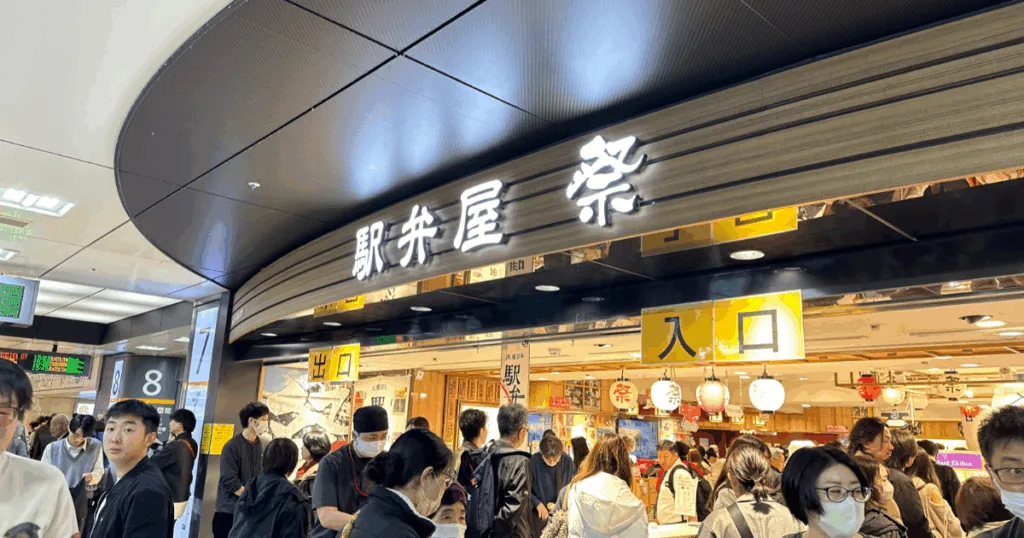
Ekibenya Matsuri is on 1F, in the Central Passage (Chuo Tsuro) inside the JR ticket gates, between the stairs to platforms 5 to 6 and 7 to 8. The Central Passage runs across the whole station from the Marunouchi side to the Yaesu side, so you will cross it from almost any JR platform.
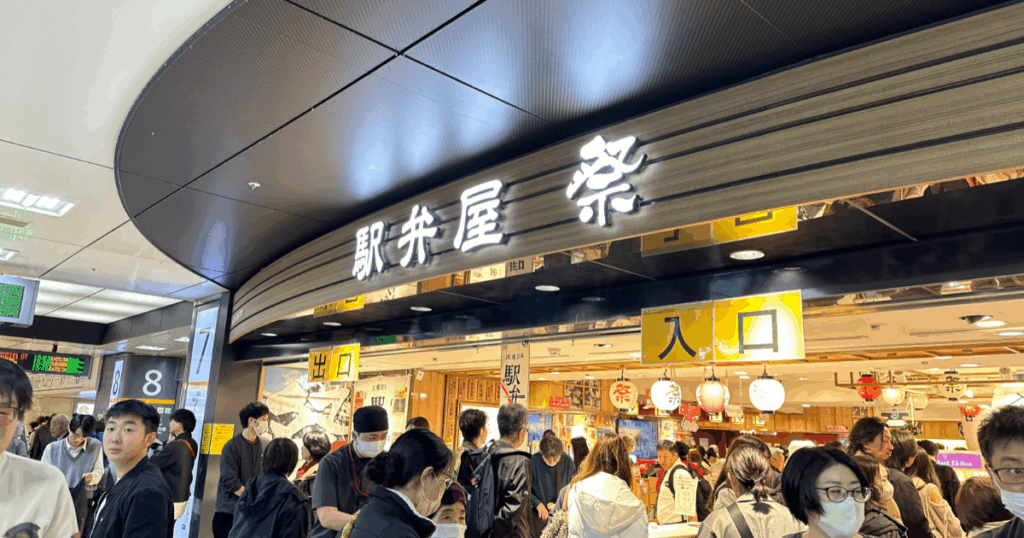
From the Marunouchi Side
Go through the Marunouchi Central Gate and walk straight ahead along the Central Passage towards the Shinkansen gates. Matsuri is on your right after a short walk.
From the Yaesu Side
Go through the Yaesu Central Gate and walk straight into the Central Passage towards Marunouchi. Look for the platform 5 to 6 and 7 to 8 stairs. The shop is between them.
From a Shinkansen
If you arrive on a Shinkansen and are changing to a JR line, go through the transfer gate into the JR area and follow signs for the Central Passage. Ekibenya Odori faces the Tokaido Shinkansen Central Transfer Gate, so it is the first of the two shops you reach from that side.
Allow an extra 5 to 10 minutes if you are pulling suitcases or walking with small children. The passage is wide, but it is one of the busiest corridors in Japan.
For exits, lifts and lockers around the rest of the station, see our Tokyo Station guide.
Do You Need a Ticket to Buy Ekiben Here?
Yes. Both shops are inside the JR ticket gates, so you need a JR ticket, a JR pass or a Suica card that you are using for a trip, or a platform ticket (nyujoken).
If you are catching a JR train from Tokyo Station, this is no problem, because you pass the shops on the way to your platform. If you only want to buy ekiben, get a platform ticket from a JR ticket machine.
JR East changed its fares in March 2026, so check the price on the machine. A platform ticket does not let you ride a train.
At Tokyo Station, neither shop has a branch outside the gates. For bento without a ticket, the Daimaru Tokyo food floor on the Yaesu side and the outside-gate shops of GRANSTA are the nearest options.
Opening Hours and When It Is Busy
Ekibenya Matsuri is open 5:30 to 22:00 every day, with no regular closing day, and Ekibenya Odori 6:00 to 21:00. Hours can change during long holidays such as Golden Week and New Year.
The shelves are fullest in the morning, when the deliveries have arrived and the best-selling boxes have not sold out. Plan around these patterns.
- Early morning (5:30 to 8:00). The first Shinkansen passengers come through, and there is a full choice and room to browse.
- Weekday commuter rush (about 7:30 to 9:30). The Central Passage itself is crowded, though most commuters are not buying ekiben.
- Late morning to lunch (about 11:00 to 13:30). This is the busiest time in the shop, with queues at the tills, and the best-selling boxes start to sell out.
- Afternoon and evening. It is quieter, but some boxes are gone for the day.
- Holiday travel days. The start of Golden Week, Obon in mid-August and the New Year holidays are the busiest days of the year.
For a family, the easiest plan is to arrive at the station 30 minutes before your train, buy at Matsuri first, then go through the Shinkansen gates. Once you are through the Shinkansen gates, the choice is much smaller.
What to Expect Inside Ekibenya Matsuri
The shop works like a small supermarket. You walk in through the entrance, take boxes from the shelves yourself, and pay at the tills on the way out.
It is busy and fast, and nobody minds if you take your time looking.
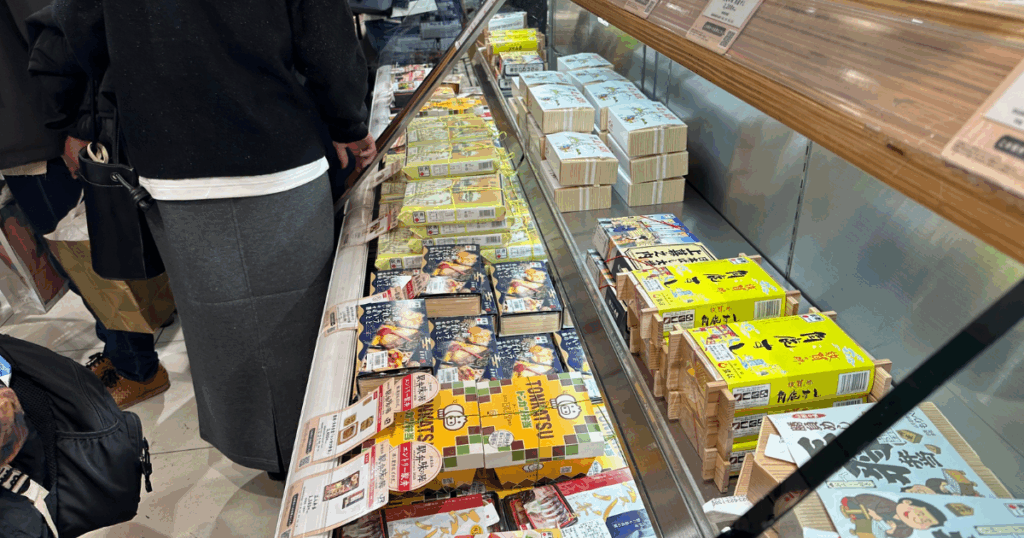
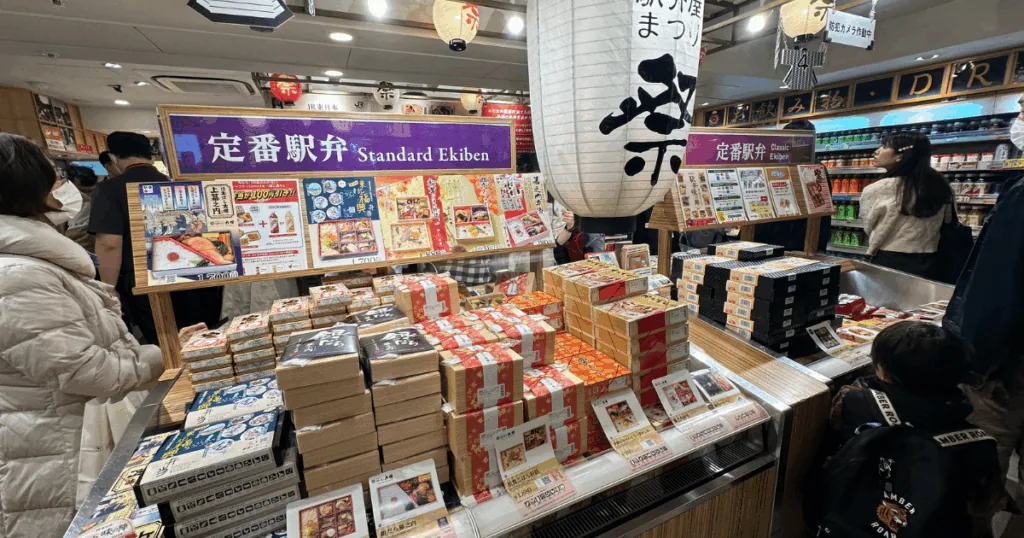
- Signs. The main shelf signs have English, such as the Standard Ekiben section of long-time best sellers.
- Labels. Each box has a label in Japanese with the name, price, ingredients and a time to eat it by. A translation app pointed at the label helps.
- Range. The shelves hold about 150 kinds, changing with deliveries and the time of day. The shop also runs ekiben fairs and limited-time boxes through the year.
- No holds. Matsuri does not take reservations or keep boxes aside. What is on the shelf is what you can buy.
Ekiben are made to eat cold or at room temperature, except for a few self-heating boxes. There is no seating in the shop and very little in the passage, so plan to eat on your train.
How to Buy and Pay
Paying is quick. Ekibenya Matsuri and Odori both take cash, credit cards, IC cards such as Suica, other e-money and barcode payments. Ask for chopsticks if they are not already on the box.
- Choose your boxes. Pick one each, as children often prefer to choose their own. Check the time on the label if you will eat much later.
- Add drinks. There are shops and vending machines along the Central Passage for tea and water.
- Pay at the till. Have your card or Suica ready. The queue moves fast.
- Bag it. Shops in Japan charge for plastic bags, so a foldable tote is useful for a family's worth of boxes.
- Head to your platform. Keep the boxes flat so the sauces stay in place.
JR East's JRE POINT can be used at Matsuri, at one point per yen. If you collect points with a JRE POINT card, show it when you pay.
Ekibenya Odori Next Door for a Faster Choice
Ekibenya Odori is the quick version of Matsuri, open 6:00 to 21:00 every day. It sells the top 10 best sellers from Ekibenya Matsuri plus the Tokyo Bento, a box of dishes from seven long-established Tokyo food shops.
With a short list, you can choose in a minute or two.
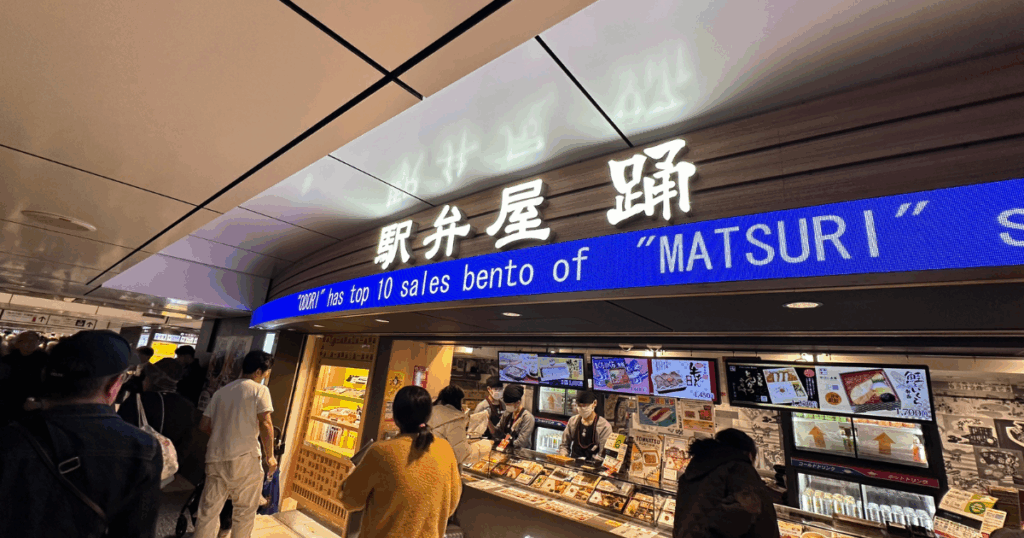
Odori is set up as a counter, with the boxes laid out in a glass case in front of the staff, so point at what you want. It stands just past Matsuri on the Central Passage, facing the Tokaido Shinkansen Central Transfer Gate, which makes it the natural stop before a train to Kyoto or Osaka.
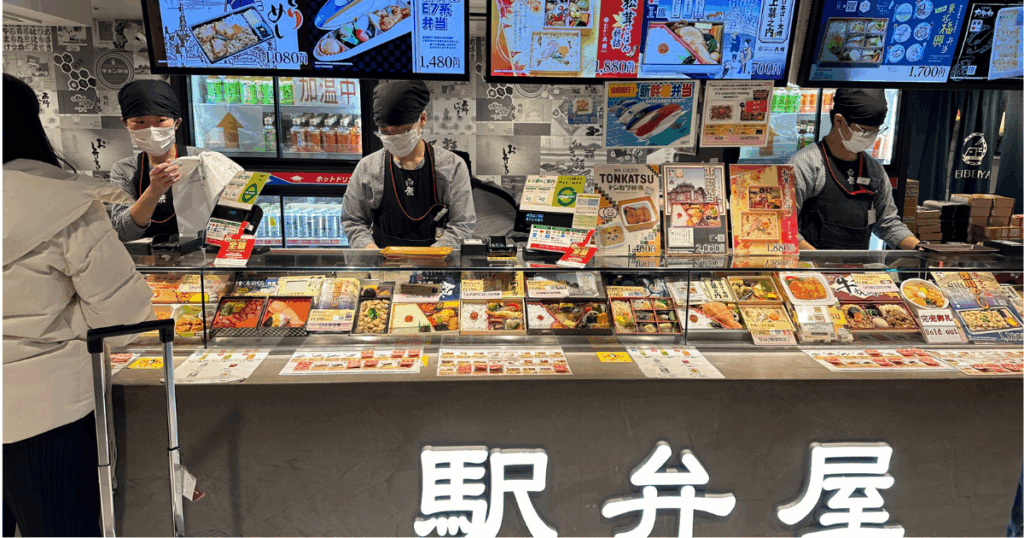
Pre-Ordering Ekiben for Pick-Up at Odori
Odori is also the pick-up counter for pre-ordered ekiben. You order online through JRE MALL Order, JR East's shop, by three days before your pick-up date, and collect at Odori on the day.
This is worth doing for a large family or a box that sells out early. The site is in Japanese, so use your browser's translation.
For larger orders or questions, the shops' customer line is 03-3213-4353 (9:00 to 19:00).

Should You Use Matsuri or Odori?
Use Matsuri if you have 20 minutes or more and want to choose from the whole range. Use Odori if you have 5 minutes or know you want a best seller.
- Before 6:00. Only Matsuri is open (from 5:30).
- Short of time. Use Odori, at the counter.
- Choosing for picky eaters. Use Matsuri, where you can see more boxes and read the labels.
- A big family order. Pre-order and collect at Odori.
- After 21:00. Only Matsuri is open (until 22:00).
Tips for Families
Ekiben are one of the easiest meals in Japan with children. Everyone picks a box, and you eat at your seat on the Shinkansen. A little planning makes the shop easier.
 ONO
Either shop is fine, but Matsuri feels bigger.
- Let the children choose. Train-shaped boxes and simple fried-chicken boxes are usually the hits. Our ekiben guide has the details.
- Allergies. The labels list ingredients in Japanese. For anyone with a serious food allergy, translate the label before buying, or choose a simple box.
- Where to eat. On the Shinkansen and limited express trains, eating at your seat is normal. Do not eat on local commuter trains such as the Yamanote Line.
- Rubbish. Take it with you, or use the bins on the train deck or platform.
- Strollers. The Central Passage is flat and there are lifts to the platforms, but the shop gets crowded. One adult can shop while the other waits outside with the stroller.
Our Shinkansen guide covers seats and luggage for the ride. On a family day in Tokyo, we plan meals around your children's appetites and any allergies.
See our private Tokyo tour with kids and our guide to things to do in Tokyo with kids, or browse all our tours in Tokyo.
Frequently Asked Questions
- Where is Ekibenya Matsuri in Tokyo Station?
-
It is on 1F, in the Central Passage inside the JR ticket gates, between the stairs to platforms 5 to 6 and 7 to 8. From the Marunouchi Central Gate, walk straight towards the Shinkansen gates. It is on your right.
- What time does Ekibenya Matsuri open?
-
It opens at 5:30 every day and closes at 22:00, with no regular closing day. Ekibenya Odori next door is open from 6:00 to 21:00. Hours can change during long holidays.
- Can I enter Ekibenya Matsuri without a train ticket?
-
You can, but only with a platform ticket (nyujoken), bought from a JR ticket machine, because the shop is inside the ticket gates. A platform ticket lets you into the station but not onto a train.
- Can I reserve ekiben at Ekibenya Matsuri?
-
No. Matsuri does not take reservations or hold boxes. You can pre-order through JRE MALL Order by three days before and collect at Ekibenya Odori.
- What is the difference between Ekibenya Matsuri and Odori?
-
Matsuri is the big shop with about 150 kinds that you browse yourself. Odori, next door, sells Matsuri's top 10 best sellers and the Tokyo Bento at a counter, for a faster choice.
- Can I pay by credit card at Ekibenya Matsuri?
-
Yes. Both shops take cash, credit cards, IC cards such as Suica, other e-money and barcode payments.
Ekibenya Matsuri
Address
JR Tokyo Station, 1 Chome-9-1 Marunouchi, Chiyoda City, Tokyo 100-0005
Nearest station
Tokyo Station (Shinkansen / Tokaido / Yokosuka / Sobu / Keihin-Tohoku / Yamanote / Chuo / Keiyo / Ueno-Tokyo / Tokyo Metro Marunouchi)
Sources
https://www.gransta.jp/mall/gransta_tokyo/ekibenyamatsuri/
https://www.gransta.jp/mall/gransta_tokyo/ekibenyaodori/
https://foods.jr-cross.co.jp/matsuri/
https://foods.jr-cross.co.jp/matsuri/information/
https://www.tokyostationcity.com/en/information/
Plan a Private Day with a Local

Every tour is private, for your group only, and planned with you before you arrive. From US$550 per group for a day on foot in Tokyo or Yokohama, or from US$890 for a day trip by train to Kamakura, Hakone or Mt. Fuji. Travelling with children? See our Tokyo private tour with kids.
Free Consultation

Japan Trails Newsletter
Free Newsletter Sign‑Up
Subscribe to our newsletter and receive a handpicked list of restaurants that Japanese locals go to.
-
 Tea Ceremony in Asakusa: 4 Experiences Compared
-
 Ekibenya Matsuri and Odori at Tokyo Station: Where They Are and How to Buy
You might also like
-
 Imperial Palace Tokyo: A Visitor Guide to the East Gardens, Nijubashi and the Palace Tour
-
 Hatsumode: A Guide to Your Japanese New Year Shrine Visit
-
 Mitsubishi Ichigokan Museum, Tokyo: A Visitor's Guide
-
Ekibenya Matsuri and Odori at Tokyo Station: Where They Are and How to Buy
-
 KITTE Marunouchi: Rooftop Garden, Free Museum and Floor Guide
-
 Tokyo Station Marunouchi Building: Red-Brick History, Domes and Photo Spots
-
 GRANSTA Tokyo Station Guide: Shop Directory, Food and Hours