Kaminarimon Gate Complete Guide

Kaminarimon Gate overview and why it is famous
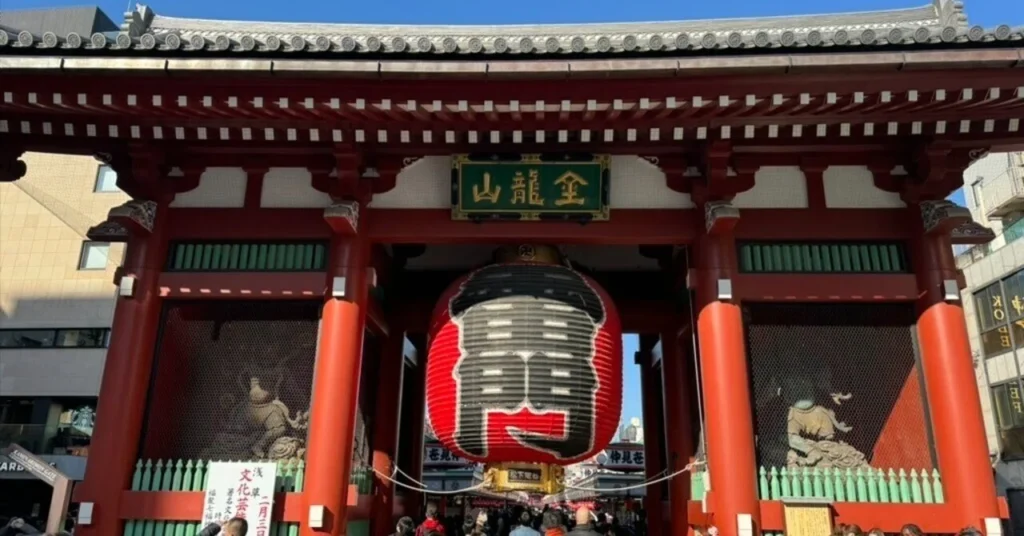
Kaminarimon Gate is one of the most instantly recognizable landmarks in Tokyo, yet its significance goes far beyond its striking appearance.
For many first-time visitors, passing through this gate marks the moment when casual sightseeing turns into a deeper cultural experience rooted in history and belief.
Understanding why Kaminarimon Gate is famous allows travelers to see Asakusa not just as a tourist district, but as a living spiritual center of Tokyo.
What Kaminarimon Gate represents in Japanese culture
Kaminarimon Gate, formally known as the Thunder Gate, symbolizes divine protection against disasters and misfortune.
It serves as a spiritual boundary separating the ordinary city from the sacred grounds of Senso-ji Temple.
In Japanese culture, passing through a temple gate represents a mental and emotional transition into a space of respect and mindfulness.
Why Kaminarimon is the symbolic entrance to Asakusa
Although Senso-ji Temple has multiple gates, Kaminarimon is universally recognized as the front entrance of Asakusa.
Facing major roads and subway exits, the gate naturally becomes the first point of contact for visitors.
Over time, this positioning established Kaminarimon as the visual and cultural symbol of Asakusa itself.
How travelers typically experience Kaminarimon today
Most visitors encounter Kaminarimon immediately after leaving Asakusa Station.
Travelers often stop to photograph the massive red lantern, look up at the gate’s details, and then proceed directly into Nakamise Street.
This blend of curiosity, excitement, and reverence defines the modern Kaminarimon experience.
Kaminarimon Gate history and reconstruction timeline
Kaminarimon Gate has a long and complex history that mirrors Tokyo’s cycles of destruction and renewal.
Rather than standing continuously for centuries, the gate has disappeared and returned multiple times.
Each reconstruction added new meaning, making the present gate a symbol of resilience rather than permanence.
Origins of Kaminarimon and early historical records
Kaminarimon was originally constructed in the 10th century as part of the expanding Senso-ji Temple complex.
Early historical records describe it as a protective gate dedicated to the gods of wind and thunder.
These deities were believed to guard the city from fires, storms, and other calamities.
The 1865 fire and the long absence of Kaminarimon
In 1865, a major fire destroyed Kaminarimon Gate completely.
Following this disaster, the gate remained absent for nearly a century.
This 95-year absence meant that for generations, Asakusa existed without its most iconic landmark, leaving a noticeable cultural and visual void.
The 1960 reconstruction by Konosuke Matsushita
Kaminarimon Gate was finally rebuilt in 1960 through a private donation by Konosuke Matsushita, the founder of Panasonic.
His contribution was motivated by personal gratitude and religious faith rather than corporate promotion.
The current gate therefore represents postwar recovery, private devotion, and the revival of cultural heritage after a long absence.
Kaminarimon Gate architecture and design details
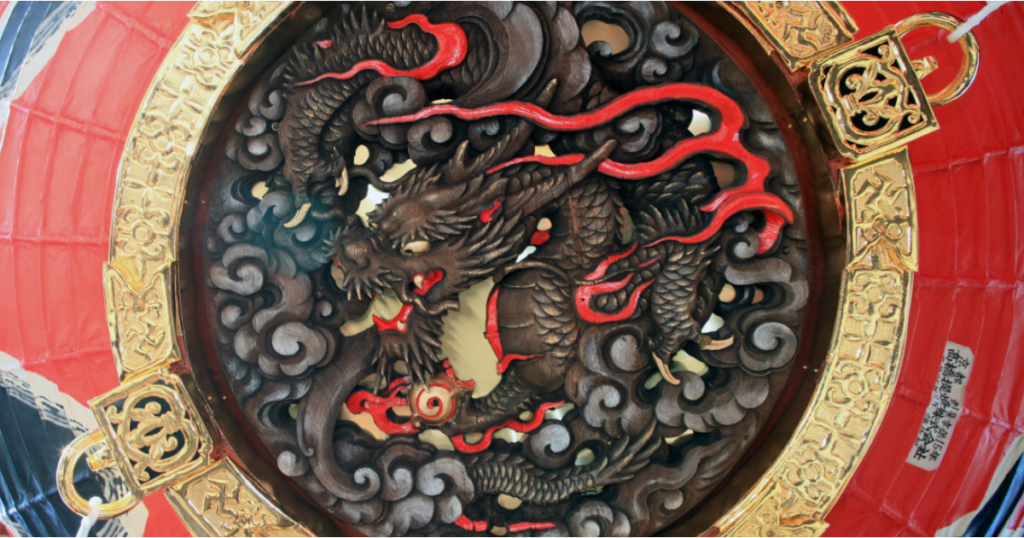
At first glance, Kaminarimon Gate appears simple, but every element of its design carries symbolic meaning.
The gate balances visual power with religious purpose, combining traditional aesthetics and modern engineering.
Paying attention to architectural details reveals why Kaminarimon feels both ancient and enduring.
Structure, dimensions, and architectural style
Kaminarimon Gate stands approximately 11.7 meters tall and 11.4 meters wide.
Although it appears to be wooden, the structure is reinforced concrete, chosen for fire resistance and durability.
This hidden modern framework allows the gate to preserve traditional appearance while meeting contemporary safety standards.
The giant red lantern and its meaning
The enormous red lantern hanging at the center of Kaminarimon weighs around 700 kilograms.
It bears bold calligraphy reading “Thunder Gate,” symbolizing divine authority and protection.
Rather than being casually replaced, the lantern is carefully repaired, renewed, and maintained over time to preserve its cultural value.
Wind God and Thunder God statues explained
Flanking the gate are statues of Fujin, the Wind God, and Raijin, the Thunder God.
These figures function as guardians rather than decoration.
Their powerful expressions remind visitors that Kaminarimon marks the entrance to a protected sacred space.
Kaminarimon Gate and Senso-ji Temple relationship
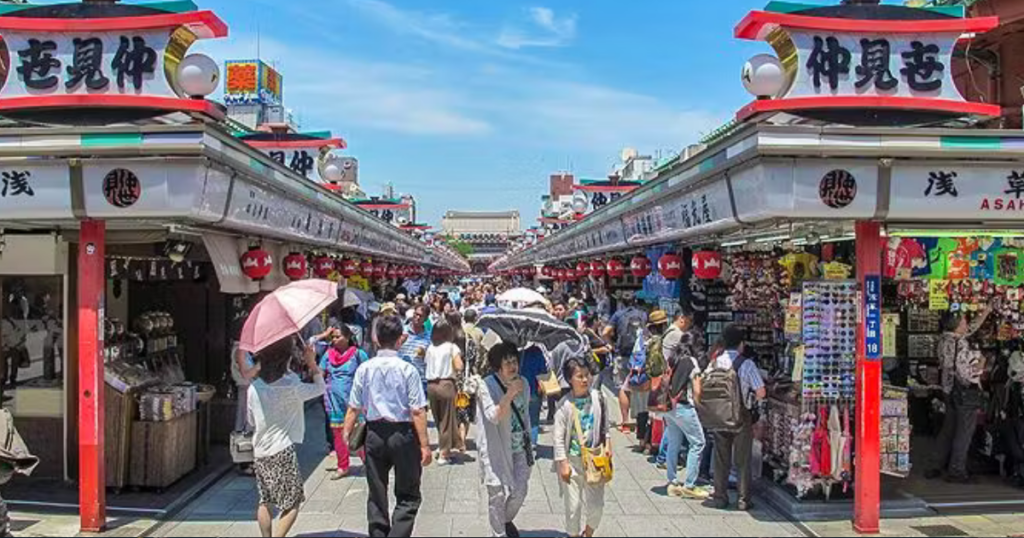
Kaminarimon Gate is inseparable from Senso-ji Temple both spatially and spiritually.
The gate organizes movement, commerce, and worship into a single continuous experience.
Understanding this relationship explains why Kaminarimon feels alive rather than museum-like.
How Kaminarimon connects to Senso-ji Temple grounds
Passing through Kaminarimon naturally aligns visitors with the central axis leading toward the temple’s main hall.
This layout is intentional, guiding the body forward while preparing the mind for worship.
Even casual visitors follow this path almost instinctively.
Nakamise Street as the path beyond Kaminarimon
Immediately after the gate begins Nakamise Street, one of Japan’s oldest shopping streets.
The transition from sacred gate to lively marketplace reflects how Buddhism in Japan integrates religious practice with everyday life.
Traditional snacks and souvenirs coexist with centuries-old rituals.
Religious significance vs tourist experience
While many visitors focus on photography and shopping, Kaminarimon remains an active religious entrance.
Local worshippers often bow lightly as they pass through.
Recognizing this dual role encourages respectful behavior without diminishing enjoyment.
Kaminarimon Gate access and best time to visit
Visiting Kaminarimon at the right time can dramatically change the experience.
Crowd levels, lighting, and seasonal conditions all influence the atmosphere.
Practical planning ensures a smoother and more memorable visit.
How to get to Kaminarimon from major Tokyo areas
Kaminarimon is a short walk from Asakusa Station, served by the Ginza Line, Asakusa Line, and Tobu Skytree Line.
From Shibuya, the Ginza Line provides direct access in approximately 34–40 minutes.
Clear English signage makes navigation easy even for first-time visitors.
| Starting Area | Train Line | Approx. Time |
|---|---|---|
| Shibuya | Ginza Line | 34–40 min |
| Ueno | Ginza Line | 5 min |
| Tokyo Station | JR + Ginza Line | 20–25 min |
Best time of day to avoid crowds
Early mornings before 9:00 AM offer the calmest atmosphere.
Late evenings provide softer lighting and fewer tour groups.
Midday, especially on weekends, tends to be the most crowded.
Seasonal differences and festival days
During festivals such as Sanja Matsuri, Kaminarimon becomes extremely crowded and energetic.
Cherry blossom season also draws large numbers of visitors.
Winter mornings, by contrast, often feel quiet and contemplative.
Kaminarimon Gate photography tips and viewpoints
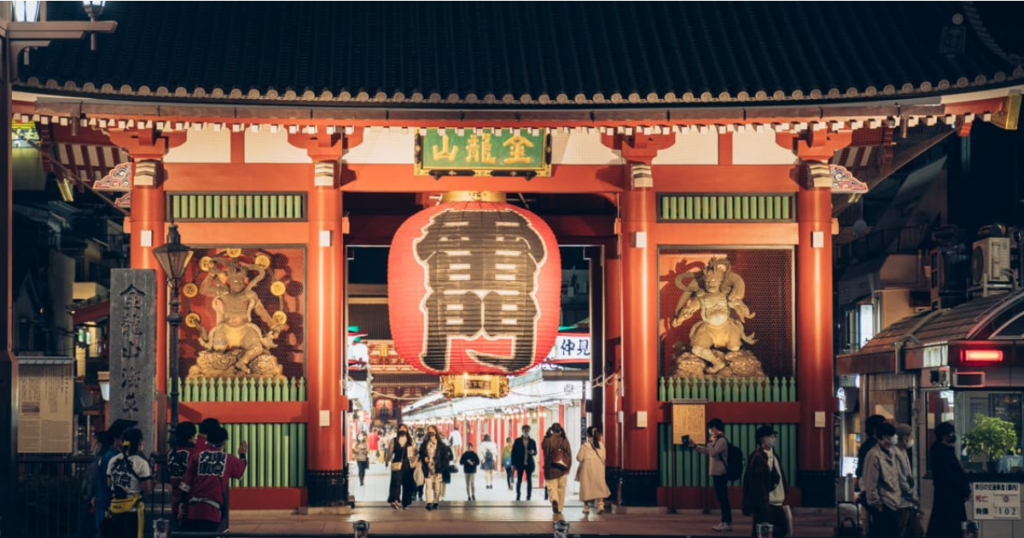
Photography plays a central role in the Kaminarimon experience, but thoughtful techniques yield better results.
Light, angles, and etiquette all matter.
Respectful photography enhances both images and atmosphere.
Best angles for photographing the lantern
Standing slightly off-center adds depth to photos of the gate.
Shooting upward emphasizes the scale of the lantern against the sky.
Close-up shots of the lantern’s underside offer a distinctive perspective.
Night photography and lighting conditions
After sunset, gentle illumination highlights the gate’s red tones.
Tripods are discouraged during busy hours, so higher ISO settings are often practical.
Night photos convey a calmer, more spiritual mood.
Crowd-aware photography etiquette in Asakusa
Avoid stopping suddenly or blocking pathways.
Step aside when framing shots.
Kaminarimon is a shared public space, not a closed photo set.
Kaminarimon Gate cultural etiquette and visitor rules
Cultural awareness enhances the Kaminarimon visit without requiring deep religious knowledge.
Simple gestures communicate respect and align with local expectations.
In Japan, behavior itself expresses understanding.
Photography manners and prohibited actions
Photography is permitted, but touching statues or climbing structures is prohibited.
Flash photography near worshippers should be avoided.
Drones are strictly forbidden.
Respecting worshippers near the gate
Some visitors pass through Kaminarimon specifically to pray.
Keeping voices low and remaining observant shows respect.
Watching local behavior often provides the best guidance.
Behavior differences between day and festival visits
During festivals, staff and volunteers actively manage crowd flow.
Following instructions is essential for safety.
Outside festival periods, personal awareness plays a larger role.
Kaminarimon Gate comparison with other Japanese temple gates
Comparing Kaminarimon with other gates clarifies why it feels unique.
Its symbolism, scale, and urban setting distinguish it from similar structures across Japan.
These factors explain its global recognition.
Kaminarimon vs other Senso-ji gates
While the inner Hozomon Gate is larger, Kaminarimon carries stronger symbolic weight.
It marks the true beginning of the temple journey.
Hozomon functions more as a protective inner barrier.
Differences from torii gates at shrines
Torii gates belong to Shinto shrines, while Kaminarimon is Buddhist.
Torii emphasize purification, whereas Kaminarimon emphasizes protection.
This contrast reflects deeper religious differences.
Why Kaminarimon stands out globally
Few religious gates combine historical depth, urban accessibility, and visual clarity like Kaminarimon.
Its lantern-centered design communicates meaning instantly across cultures.
This clarity supports its worldwide fame.
Kaminarimon Gate FAQs for first-time visitors
First-time visitors often share similar questions about Kaminarimon.
Clear answers reduce uncertainty and improve planning.
These FAQs address practical concerns directly.
- Is Kaminarimon free to visit?
-
Yes, Kaminarimon Gate is open 24 hours a day and free to enter. As part of a public religious site, there is no admission fee. Donations are voluntary.
- Can you touch the lantern?
-
No, touching the lantern is discouraged. It is a sacred object and carefully maintained. Photography is allowed without physical contact.
- How long should you spend at Kaminarimon?
-
Most visitors spend about 10–20 minutes at the gate itself. Including Nakamise Street and Senso-ji Temple, plan at least 1.5 to 2 hours. Early visits often encourage longer stays.
Kaminarimon Gate
Adress
Tokyo, Taito City, Asakusa, 2-3-1
Nearest station
Asakusa Station (Ginza Line / Tobu Skytree Line / Toei Asakusa Line / TX Asakusa Line)
Japan Trails Newletter