The Japanese Tea Ceremony Explained: A First-Timer's Guide

Quick answer
- The Japanese tea ceremony (chanoyu or sado) is the ritual preparing and serving of matcha to guests.
- Visitor sessions last 30 to 90 minutes.
- Eat the sweet first, turn the bowl before you sip, and follow the host.
What Is the Japanese Tea Ceremony?
The Japanese tea ceremony is the ritual preparation and serving of matcha, powdered green tea, by a host to guests in a quiet room. In Japanese it is called chanoyu ("hot water for tea") or sado / chado ("the way of tea").
The drink is only part of the ceremony. Every movement, from folding the cloth to placing the bowl, is set, so that host and guests can give a few minutes their full attention.
Japan's tourism board lists tea alongside incense appreciation and flower arranging as one of the three classical arts of refinement. For a visitor, it is one of the few traditions you take part in rather than watch.
You eat the sweet, drink from the bowl, and in most sessions whisk a bowl yourself.

A Short History of the Way of Tea
Tea came to Japan from China with Buddhist monks, and the ceremony grew out of Zen monasteries before becoming an art of samurai and merchants. Only a few dates matter.
- 815. The earliest record of tea in Japan, when the monk Eichu served tea to Emperor Saga.
- 12th to 15th centuries. Powdered tea spreads through Zen temples and then to the warrior class, who hold lavish tea gatherings.
- 16th century. Sen no Rikyu (1522 to 1591), tea master to the warlords Oda Nobunaga and Toyotomi Hideyoshi, perfects a plain, rustic style built on the wabi aesthetic, with tiny tearooms, simple bowls and bamboo utensils.
- After Rikyu. His descendants found the three Sen family schools, including Urasenke and Omotesenke, which still teach the tradition today.
Rikyu's ideals are usually summed up in four words, harmony, respect, purity and tranquillity (wa, kei, sei, jaku). Hosts also speak of ichigo ichie, "one time, one meeting".
Each gathering happens once and will never be repeated exactly, so it deserves care.
Types of Tea Ceremony You Can Join
Visitors have three realistic choices, from a full formal gathering to a 30-minute introduction. Pick by how much time your day has and how long your children can sit.
| Type | Length | What you get | Best for |
|---|---|---|---|
| Chaji (formal gathering) | About 4 hours | A kaiseki meal, thick tea, then thin tea | Adults with a deep interest |
| Chakai or visitor ceremony | 45 to 90 min | A sweet, a bowl of thin tea, often whisking your own | Most first-timers |
| Matcha workshop or garden teahouse | 15 to 40 min | A bowl of matcha and a sweet, little ritual | Families with young children |
Chaji is the full form, and few places offer it to walk-in visitors. Chakai is a lighter gathering, and almost every "tea ceremony experience" for travellers is a version of it, usually with an English explanation.
At the short end, garden teahouses serve a bowl of matcha and a sweet with no ceremony at all.
You will also hear two words for the tea itself. Usucha (thin tea) is frothy and light, and it is what visitors are served. Koicha (thick tea) is a dense, almost paste-like tea shared from one bowl at formal gatherings.

What Happens at a Tea Ceremony Step by Step
A visitor ceremony follows the same order almost everywhere, with a welcome, a sweet, the host's preparation, your bowl and a closing bow.
- Shoes off and a short wait. You leave shoes at the entrance and may wait in an anteroom. Some venues have a stone basin where you rinse your hands.
- Entering the room. You bow at the door, look at the hanging scroll and flowers in the alcove (they are chosen for the season), and sit where the host shows you.
- The sweet. Each guest is given a wagashi, a small seasonal sweet. Eat it before the tea. Its sweetness balances the bitterness of matcha.
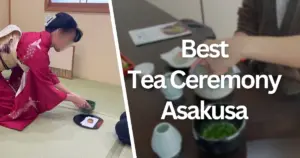
- The host prepares tea. In silence, the host purifies each utensil with a silk cloth, scoops the matcha, adds hot water from the kettle and whisks it to a froth.
- Receiving the bowl. The bowl is placed in front of you with its decorated front facing you. You bow, lift it with your right hand onto your left palm, and turn it a little clockwise so you do not drink from the front.
- Drinking. Finish the bowl in a few sips. A small slurp on the last sip is polite. It tells the host you have finished.
- Admiring the bowl. Turn it back, set it down, and look at it. Asking about the bowl is a compliment.
- Whisking your own. In most visitor sessions, you then make a bowl yourself with the host's help.
- Closing. Host and guests bow, and the host explains anything you want to ask about.

The main utensils are worth knowing by name, because hosts will use them. They are the chawan (tea bowl), chasen (bamboo whisk), chashaku (bamboo tea scoop), natsume (tea caddy), and the iron kama (kettle).
Tea Ceremony Etiquette for Visitors
Nobody expects a first-time visitor to know the rules, and the host will tell you what to do as you go. These habits cover nearly everything.
- Wear clean socks, because shoes come off before the tatami.
- Bow when you enter, when the bowl is placed in front of you, and at the end.
- Use both hands for the bowl.
- Eat the sweet first, then drink the tea.
- Turn the bowl before you drink, and turn it back before you set it down.
- Do not walk on the edges of the tatami mats, and do not step over utensils.
- Keep quiet while the host prepares the tea. Questions are welcome before and after.
- Ask before you take photos. Most visitor venues allow them, but not at every moment.
If kneeling is a problem, say so. Kneeling in seiza for an hour is hard for anyone not used to it. Many visitor venues use chairs or let you sit cross-legged, and there is even a table-and-chair style of tea called ryurei, developed in the Meiji era for foreign guests.
What to Wear to a Tea Ceremony
Wear comfortable, modest clothes you can sit on the floor in, and clean socks. You do not need a kimono. Hosts dress formally, but visitors are not expected to.
- Loose trousers or a long, wide skirt are easier for kneeling than jeans or a short skirt.
- Leave off strong perfume, which competes with the smell of the tea.
- Take off rings, bracelets and large watches if you can, so they do not knock or scratch the bowls.
Many families do wear kimono for the ceremony, and it makes good photos. Some tea venues include kimono. Otherwise, rent one nearby first.
Our guide to kimono rental in Asakusa covers children's sizes.

How Much Does a Tea Ceremony Cost?
A visitor tea ceremony in Tokyo or Kyoto usually costs a few thousand yen per person for 45 to 90 minutes, and more with kimono. In Asakusa in October 2026, for example, prices run from ¥3,850 for about an hour in a real tearoom to ¥12,100 for a package with kimono, dressing and hair.
At the low end, a garden teahouse serves a bowl of matcha and a sweet for the price of a café drink, plus garden entry. A full chaji with a meal is a different category, and is usually arranged through a tea teacher rather than booked online.
Most venues take reservations, and small rooms fill up at weekends and in spring and autumn. Tell them your children's ages and anyone who cannot kneel when you book.
Where to Try a Tea Ceremony in Japan
You can join a tea ceremony in any big city, but Kyoto and Tokyo have the most choice in English.
Tokyo
In Tokyo, Asakusa has the most tea ceremonies within walking distance of a big sight, so it is easy to fit one into a morning at Senso-ji. We compared four of them, with prices, lengths and which suit children, in our guide to tea ceremonies in Asakusa.
For something with no booking at all, the city's traditional gardens have teahouses. At Hama-rikyu Gardens, the teahouse on an island in the tidal pond serves matcha and a sweet.
Garden entry is ¥300 for adults, and free for primary school children and younger. Several large hotels also have tearooms in their gardens.
Kyoto
Kyoto is where Rikyu worked and where the Sen family schools are based, and Uji, just south of the city, is Japan's best-known tea-growing district. Temples, tea houses in Gion and around Kiyomizu-dera, and machiya townhouses all run sessions for visitors.
Other places
Kanazawa, with its gardens and old teahouse districts, is another good choice. Outside the cities, tea-growing regions such as Shizuoka have tea farms and shops where you can taste fresh tea.
Tea Ceremony with Kids
A tea ceremony works for children when it is short and hands-on. They eat the sweet, whisk a bowl, and are done in under an hour.
It goes badly when they have to kneel and listen for a long time.
- With children under seven, choose a session of about 45 minutes or a garden teahouse.
- Let them whisk. It is the part children remember.
- Expect them to prefer the sweet. Matcha is bitter, and it contains caffeine. A few sips is plenty for a young child.
- Book chairs if grandparents or small children will struggle to kneel.
- Check the minimum age before you pay. Some tearooms do not take young children.
 ONO
I recommend a tea ceremony if you like matcha, but it is a low priority. Children usually get bored, and many people expect sweet matcha. It is good if you come to learn about traditional culture, less so if you only want something to drink.
On a family day in Tokyo, I fit the tea ceremony between the temple in the morning and lunch, which keeps it short and gives the children something to do with their hands. If you would like it booked and planned around naps and lunch, that is part of our private Tokyo tour with kids.
For more of the city, see things to do in Tokyo with kids and our tours in Tokyo.
Bringing Tea Home
The easiest souvenir is matcha powder and a bamboo whisk, so you can make it again at home. Tea utensil shops and many tea ceremony venues sell bowls, whisks, scoops and tins of matcha.
- Buy small tins. Matcha loses its colour and flavour quickly once opened. Keep it in the fridge.
- Look for ceremonial grade if you want to drink it as tea, rather than the cooking grade used for sweets.
- Bowls are fragile. Ask the shop to wrap them for travel.
Frequently Asked Questions
- How long does a Japanese tea ceremony last?
-
Visitor sessions last about 45 to 90 minutes, and short matcha workshops about 30 to 40. A full formal chaji, with a kaiseki meal and two kinds of tea, takes about four hours.
- Do I need to speak Japanese?
-
No. Sessions for visitors are explained in English, and the host shows you each step. Hosts expect beginners to make small mistakes and do not mind.
- Why do you turn the tea bowl?
-
The bowl has a front, usually its most decorated side, which the host turns towards you as a courtesy. You turn it away so you do not drink from the front, and turn it back afterwards.
- Can children join a tea ceremony?
-
Yes, at most visitor venues, though some tearooms set a minimum age. Choose a session of about 45 minutes, ask for chairs if needed, and tell the venue your children's ages when you book.
- What is the difference between matcha and the tea ceremony?
-
Matcha is the powdered green tea. The tea ceremony is the ritual way of preparing and serving it, with set movements, utensils and etiquette. You can drink matcha anywhere. The ceremony is the art around it.
- Do I have to wear a kimono?
-
No. Neat, comfortable clothes and clean socks are fine. Many visitors choose to wear kimono for photos, and some venues include it in the price.
Sources
https://www.japan.travel/en/guide/tea-ceremony/
https://www.urasenke.or.jp/texte/index.html
https://www.urasenke.or.jp/texte/about/index.html
https://www.omotesenke.jp/english/
https://www.tokyo-park.or.jp/teien/en/hama-rikyu/outline.html
Plan a Private Day with a Local

Every tour is private, for your group only, and planned with you before you arrive. From US$550 per group for a day on foot in Tokyo or Yokohama, or from US$890 for a day trip by train to Kamakura, Hakone or Mt. Fuji. Travelling with children? See our Tokyo private tour with kids.
Free Consultation

Japan Trails Newsletter
Free Newsletter Sign‑Up
Subscribe to our newsletter and receive a handpicked list of restaurants that Japanese locals go to.