The Three Wise Monkeys at Nikko Toshogu Shrine
Quick answer
- The Three Wise Monkeys are carved on the Shinkyusha (Sacred Stable) at Nikko Toshogu Shrine, on your left just after the first gate, the Omotemon.
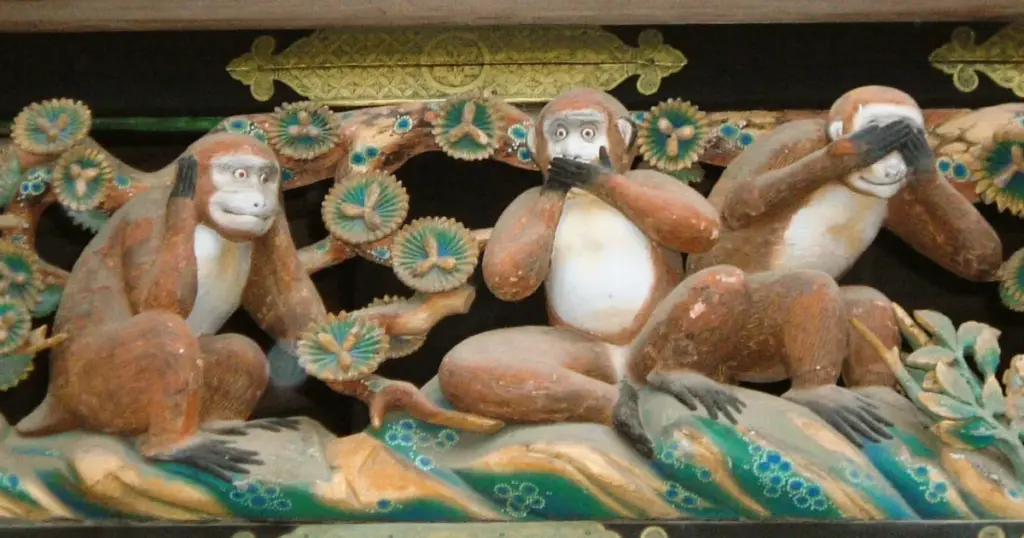
- The monkeys are Mizaru, Kikazaru and Iwazaru, meaning "see not, hear not, speak not".
- Monkeys were believed to protect horses, which is why they decorate a stable.
Where Are the Three Wise Monkeys at Nikko Toshogu?
They are on the Shinkyusha, the Sacred Stable of Nikko Toshogu Shrine. Walk up the stone steps, through the first gate (the Omotemon, with its two guardian figures), and the stable is the plain wooden building on your left, a minute inside the paid area.
It is hard to miss, because there is usually a crowd in front of it with phones raised.
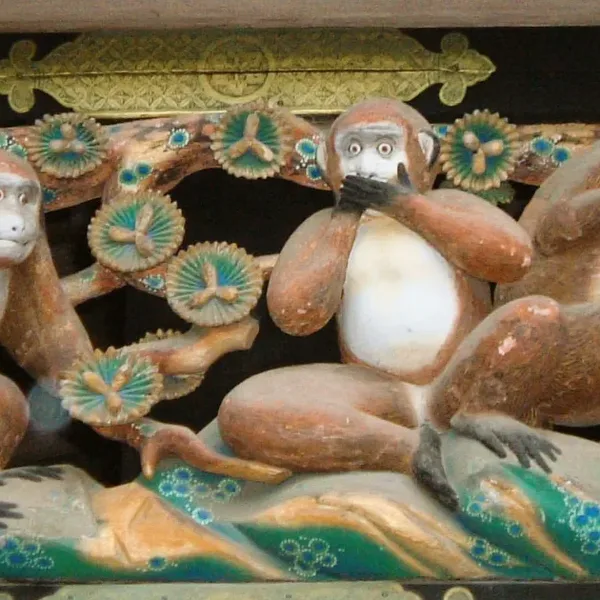
Look up at the band of carvings above the stable's openings. There are eight monkey panels, painted in bright colours against the dark wood, running around the building.
The best-known one, with the monkeys covering their eyes, ears and mouth, is the second panel, counted from the left as you face the stable from the path.
The Shinkyusha is where the shrine keeps its sacred horse (shinme). It is an Important Cultural Property, and unlike most of Toshogu it is left largely as unlacquered wood, which makes the coloured panels stand out.

What Do the Three Wise Monkeys Mean?
The three monkeys teach that you should not look at, listen to or speak of what is wrong. Each monkey has a name.
| Monkey | Gesture | Meaning |
|---|---|---|
| Mizaru | Covers its eyes | Do not see |
| Kikazaru | Covers its ears | Do not hear |
| Iwazaru | Covers its mouth | Do not speak |
The names are also a play on words. In Japanese, -zaru is an old verb ending meaning "not", and saru means monkey. "Mizaru, kikazaru, iwazaru" therefore means both "see not, hear not, speak not" and, to the ear, "three monkeys".
That is why the carving is called Sanzaru ("three monkeys") in Japanese. The word "wise" is an English addition.
At Nikko, the message is about raising children. The shrine's own description says the eight panels portray a human life. In that story, the three monkeys are young, and the lesson is that children should be shielded from bad things while they grow up, not that adults should look away from wrongdoing.
The English phrase "see no evil" is often used in that second, negative sense, which is not what the carving was meant to say.
Why monkeys on a horse stable? Because in Japan monkeys were long believed to protect horses. The shrine itself gives this as the reason the Sacred Stable is decorated with monkeys.
The panels therefore do two jobs. They guard the sacred horse, and through the life story they carry a moral lesson for the people who walk past.
The Eight Monkey Panels as a Life Story in Wood
The three monkeys are one scene in a sequence. The shrine says the eight panels together picture the course of a person's life. The scenes below follow the usual reading, starting from the panel on the left.
- A mother and her baby. A mother monkey shades her eyes and looks into the distance, holding her child, which shows a parent's hopes for the future.
- The three monkeys. This panel stands for childhood and the lesson of "see not, hear not, speak not".
- A young monkey alone. The monkey grows up and stands on its own.
- Looking upward. This scene shows young adults with high ambitions, under a blue cloud.
- On the edge of a cliff. A monkey faces a setback, and a friend offers comfort.
- Thinking of love. A young monkey is lost in thought, as people are when they fall in love.
- Facing rough waves. A couple meets life's hardships together.
- A mother-to-be. A pregnant monkey appears, and the cycle returns to the first panel.
Walk all the way round the stable to see every panel. Most visitors photograph the second and move on, so the later scenes are often quieter.
Who Carved Them, and How Old Are They?
The panels date from the 1630s. Most of Toshogu's present buildings, 55 in all, were rebuilt in 1636 for the 20th anniversary of Tokugawa Ieyasu's enshrinement, in a building programme that took only one year and five months.
The carver of the monkey panels is not named on the shrine's own pages. You will often read that they are by Hidari Jingoro, the legendary craftsman, but the shrine attributes to him only the nearby Sleeping Cat, and even that is "said to be" his work.
It is safer to say the panels are the work of the shrine's 17th-century carvers.
The colours you see are not 400 years old. The carvings are outdoors in a damp mountain climate, and they are restored and repainted from time to time, so the faces can look a little different from photos taken years ago.
Where the "See No Evil" Saying Comes From
The idea is much older than Nikko. A line in the Analects of Confucius tells students not to look at, listen to or speak of anything contrary to proper conduct.
The teaching reached Japan through Chinese learning and Buddhism, and three monkeys in these poses had become a familiar image in Japan by the time Toshogu was built, including in the folk belief of Koshin.
Nikko's carving made the image known worldwide, and versions of it are now found everywhere from Europe to the Americas. Some later versions add a fourth monkey, Shizaru ("do no evil"), covering its body or lap. There is no fourth monkey at Toshogu.
Tickets, Hours and When to Go
To see the monkeys, buy the standard Toshogu ticket. The Sacred Stable is inside the paid area.
- Admission. Tickets cost ¥1,600 for adults and high school students and ¥550 for primary and junior high school students. Pay in cash at the ticket counter.
- Hours. 9:00 to 17:00 from April to October, and 9:00 to 16:00 from November to March. Ticket sales end 30 minutes before closing.
- What the ticket covers. It covers the Sacred Stable, Yomeimon Gate, the main halls, the Sleeping Cat and the climb to the Okumiya inner shrine, and the Honjido hall with the Crying Dragon.
- Getting there. From Tobu-Nikko or JR Nikko Station, the World Heritage Tour bus takes about 13 minutes to the Omotesando stop. For trains from Tokyo and the NIKKO PASS, see our Nikko day trip guide.
Go early. The stable is right at the start of the visit, so tour groups bunch up in front of it from mid-morning. Arriving at 9:00 gives you the panels with far fewer people.
In October and November, the autumn colour season, it is busiest of all.
Other Carvings to Find at Toshogu
Find the elephants, the cat and the Yomeimon Gate next. Together with the monkeys, the elephants and the cat are often called Toshogu's three best-known carvings, and the same ticket covers all of them.
1. The Imagined Elephants
On the upper of the three storehouses (the Sanjinko), just past the stable, are two large elephants based on a design by the painter Kano Tan'yu, who had never seen a real one. Children enjoy spotting what is not quite right about them.
2. The Sleeping Cat
Above the passage to the Okumiya, a small cat sleeps among peonies in the sun. It is a National Treasure, said to be by Hidari Jingoro.
Beyond it, a long flight of stone steps climbs through the cedars to Ieyasu's tomb.
3. Yomeimon Gate
The gate is a National Treasure with over 500 carvings of old stories, children at play and sages. It is nicknamed the "gate where the day goes by", because you could look at it until dark.
For the whole shrine, see our guide to Nikko Toshogu Shrine and the Sleeping Cat.
Seeing the Three Wise Monkeys with Kids
The monkeys are the easiest way to get children interested in Toshogu. Before you go, show them a picture and ask them to find the panel and name which monkey covers what.
Then send them on to the elephants, the dragon and the cat.
- Age. Children from about 6 enjoy the spotting. Toddlers will be carried for much of the visit.
- Strollers. The shrine has gravel paths and many stone steps. A baby carrier is easier.
- Behaviour. Toshogu is an active shrine where people come to pray. Talk quietly, keep children off the steps of the halls, and do not let them touch the carvings.
 ONO
I have seen the Three Wise Monkeys myself, and I recommend them to families.
For other ideas, see our day trips from Tokyo, or compare Nikko with Mt. Fuji and Hakone. Our private tours are on foot in Tokyo and Yokohama.
Your guide rides the trains with you, and each of you pays your own fare with an IC card. See our Tokyo private tour with kids.

Photos and Etiquette at the Sacred Stable
You can photograph the monkey panels, because the stable is outdoors. Inside some of the halls photography is not allowed, so follow the signs as you go.
- Step back. A short zoom from the path frames the whole panel, and you will not block others.
- Take turns. Take your photo and move aside. The space in front of the stable is narrow.
- No touching. The carvings and the beam are cultural properties.
- If the sacred horse is in the stable, do not feed or touch it.
Frequently Asked Questions
- Where are the three wise monkeys in Nikko?
-
They are on the Shinkyusha (Sacred Stable) of Nikko Toshogu Shrine, on the left just after the Omotemon gate. Look for the second of eight monkey panels on the stable's beam.
- What do the three wise monkeys mean?
-
They mean "see not, hear not, speak not." At Toshogu, the eight panels show a person's life, and the three monkeys stand for childhood. Children should be kept from seeing, hearing and saying bad things while they grow up.
- Why are the three monkeys on a stable?
-
In Japan, monkeys were believed to protect horses, so the shrine decorated the stable of its sacred horse with monkey carvings.
- How much does it cost to see the three wise monkeys?
-
They are inside Nikko Toshogu's paid area, where tickets cost ¥1,600 for adults and high school students, ¥550 for primary and junior high students, paid in cash at the counter.
- Who carved the three wise monkeys?
-
The shrine does not name the carver. They are often credited to Hidari Jingoro, but the shrine attributes only the Sleeping Cat to him. The panels date from Toshogu's rebuilding in 1636.
- Is there a fourth monkey?
-
Not at Nikko. A fourth monkey, Shizaru ("do no evil"), appears in some later versions elsewhere, but Toshogu has only the three.
Three Wise Monkeys, Nikko Toshogu
Address
2301 Sannai, Nikko, Tochigi 321-1431
Nearest station
Omotesando Bus Stop (World Heritage Meguri Bus from JR Nikko / Tobu-Nikko Stations)
Shinkyo Bus Stop (World Heritage Meguri Bus from JR Nikko / Tobu-Nikko Stations)
Sources
https://toshogu.jp/pages/29/
https://toshogu.jp/pages/25/
https://www.visitnikko.jp/en/spots/nikko-toshogu-shrine/
https://www.tobu.co.jp/en/access/nikko/
Plan a Private Day with a Local

Every tour is private, for your group only, and planned with you before you arrive. From US$550 per group for a day on foot in Tokyo or Yokohama, or from US$890 for a day trip by train to Kamakura, Hakone or Mt. Fuji. Travelling with children? See our Tokyo private tour with kids.
Free Consultation
Japan Trails Newsletter
Free Newsletter Sign‑Up
Subscribe to our newsletter and receive a handpicked list of restaurants that Japanese locals go to.
-
 British Embassy Villa Nikko and the Italian Embassy Villa on Lake Chuzenji
-
 Nikko Toshogu Shrine: Tickets, Highlights and the Sleeping Cat
You might also like
-
Nikko Toshogu Shrine: Tickets, Highlights and the Sleeping Cat
-
British Embassy Villa Nikko and the Italian Embassy Villa on Lake Chuzenji
-
 Lake Chuzenji, Nikko: The Lake, Ryuzu Falls and Senjogahara
-
 Irohazaka, Nikko: The 48-Bend Road to Lake Chuzenji
-
 Shinkyo Bridge, Nikko: The Sacred Red Bridge at the Gate of the Shrines
-
 Nikko Futarasan Shrine: The Shrine of Nikko's Sacred Mountains