Hakone Shrine: The Torii Gate on Lake Ashi and How to Visit

Quick answer
- Hakone Shrine is free to enter, and the grounds and the lakeside torii gate are open at all hours.
- The charm office is open 8:15 to 17:00, and the Treasure Hall costs ¥500 for adults and ¥300 for children.
- From Moto-Hakone port, where the Lake Ashi pirate ship docks, the shrine is a 10-minute walk.
What Is Hakone Shrine?
Hakone Shrine is the main Shinto shrine of Hakone, on the south-east shore of Lake Ashi in Moto-Hakone. It is best known for the red Peace Torii standing in the water, and for the long stone stairway that climbs through old cedars to the main hall. Entry to the grounds is free.
The shrine says it was founded in 757 by the monk Mangan, who built a hall by the lake for the gods of the Hakone mountains. Worship on the mountain itself is much older.
In the late 12th century Minamoto no Yoritomo, who went on to found the Kamakura shogunate, sheltered here and later returned to pray, and warriors and travellers on the old Tokaido road kept coming for centuries. The present main hall was rebuilt in 1936 after a fire.
Three deities, Ninigi-no-Mikoto, Konohanasakuya-hime and Hikohohodemi-no-Mikoto, are enshrined together as Hakone Okami. People come to pray for safe travel, for success, and, at the Kuzuryu Shrine beside the main hall, for a good marriage.
It is a place of worship first and a photo spot second. Explain this to children before you arrive.


Hours and Fees
The grounds are free and open at all hours. Only the offices and the Treasure Hall keep set times, and these are the hours the shrine publishes for a normal day.
| What | Hours | Fee |
|---|---|---|
| Grounds and Peace Torii | Always open | Free |
| Charms (omamori) and goshuin stamps | 8:15 to 17:00 | Charms from a few hundred yen |
| Prayer ceremonies (gokito) | 8:30 to 16:00 | By offering |
| Treasure Hall (Homotsuden) | 9:00 to 16:30 | ¥500 adults, ¥300 primary school children |
The Treasure Hall is open every day but closes now and then to change its exhibitions. The shrine's front page gives 16:00 as its closing time and its history page 16:30, so plan to be inside before 16:00.
Adults here means junior high school age and over. Group rates start at 25 people.
There is no ticket gate anywhere else. You walk in from the lake or the road, wash your hands at the water basin, and climb to the main hall.
The Peace Torii in Lake Ashi
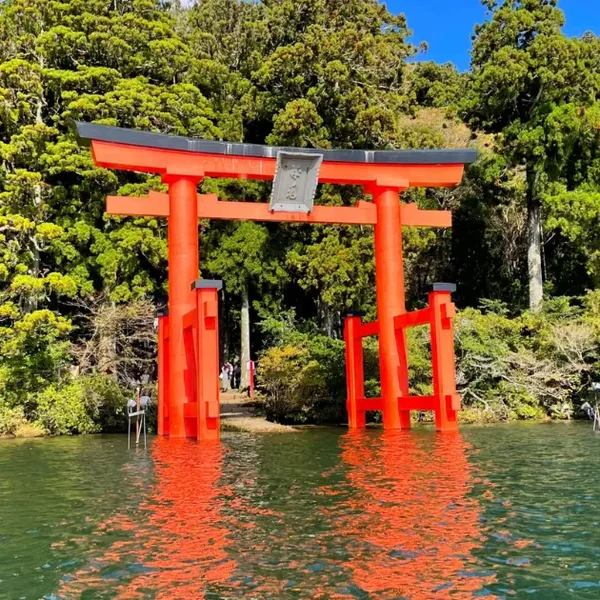
The Heiwa no Torii (Peace Torii) is the red gate standing in the shallows below the shrine, and it is why most visitors come. It was built in 1952 to mark the Treaty of San Francisco, which ended the Allied occupation of Japan.
In 1964, for the shrine's 1,200th anniversary and the Tokyo Olympics, a plaque reading "Peace" was added, written by former prime minister Shigeru Yoshida.

The photo queue
At the foot of the gate there is a small stone platform, and people queue to have their photo taken standing under it, one group at a time. On weekends, in the autumn colour season and around midday the queue runs up the lakeside path and can take a long time. There are two ways round it.
- Go early. The gate is always open, and before 9:00 the queue is short.
- Photograph it from the water. The pirate ships and the small boats from Moto-Hakone pass right in front of the gate, which gives the classic view with no queue at all.
On a clear day the gate also lines up with Mt. Fuji from the Moto-Hakone side of the lake. Winter mornings give the best chance.
In summer the mountain is often in cloud.
 ONO
Yes, I think it is worth queuing for a photo at the Peace Torii.
Shrine etiquette at the gate
The torii is a sacred gateway, not a stage. Bow briefly before stepping under it, take your photo, and give the platform back to the next group.
Do not climb on the posts or the stone base.
How to Get to Hakone Shrine
The easiest way is by boat. The Lake Ashi sightseeing cruise (the "pirate ship") docks at Moto-Hakone port, and the shrine is about a 10-minute walk along the lake from there.
That is how most families arrive on the classic Hakone loop.
| From | How | Time |
|---|---|---|
| Moto-Hakone port | Walk along the lake | About 10 min |
| Hakone-Yumoto Station | Bus to Moto-Hakone | About 60 min |
| Odawara Station | Bus to Moto-Hakone | About 75 min |
| Togendai (end of the ropeway) | Lake Ashi cruise to Moto-Hakone | About 25 to 35 min, then walk |
The bus stop to use. Since April 2022 buses do not stop at "Hakone Jinja-iriguchi" between 10:00 and 16:00. Get off at Moto-Hakone port instead and walk.
Outside those hours the shrine stop is still served.
On the Hakone Freepass. The Hakone Tozan buses to Moto-Hakone and the Lake Ashi cruise are both covered by the Hakone Freepass. The pass usually pays for itself if you ride the whole loop of mountain train, cable car, ropeway, boat and bus.
By car. The shrine has its own car park, and Moto-Hakone is reached by the Hakone Shindo road or Route 1. Weekend traffic around the lake is heavy, so arrive early.
The shrine asks that parking questions go to its office.
What to See in the Shrine Grounds
Beyond the torii, the grounds hold five more sights, all within a few minutes of each other on foot.
1. The stone stairway and cedar avenue
From the lake, the approach climbs a long stone stairway lined with lanterns and tall cedars. It is the most atmospheric part of the visit, especially in the morning mist.
Take the steps slowly with small children, because there are many of them.
2. The main hall (Haiden)
The vermilion hall at the top is where you pray. Put a small coin in the offering box, then bow twice, clap twice and bow once.
Photographs of the outside are fine. Do not photograph people at prayer at close range.

3. Kuzuryu Shrine Shingu
Immediately to the right of the main hall is the Kuzuryu Shrine Shingu, a branch of the shrine to the nine-headed dragon god of Lake Ashi. Its monthly rites are held on the 15th, and its main festival on 29 April.
4. The dragon water (Ryujinsui)
Next to Kuzuryu Shrine, water pours from the mouths of nine bronze dragon heads into a stone basin. It is a favourite with children. Use it as you would any shrine water, rinsing your hands rather than playing in it.

5. The Treasure Hall
The Homotsuden holds the shrine's collection, including documents and objects linked to the warriors who prayed here. It is a short visit, 20 to 30 minutes, and a good choice on a rainy day. See the hours and fees above.
Kuzuryu Shrine Honmiya and Hakone Motomiya
The shrine has two other sites around the lake, both of which take extra time and planning.
Kuzuryu Shrine Honmiya is the original dragon shrine, in the woods on the east shore near Hakone-en. You reach it on foot in about 30 minutes from Hakone-en or Kojiri, through the Kuzuryu no Mori forest (¥600 entry), or by motorboat from the Hakone Hotel or Hakone-en piers.
The Honmiya holds its monthly rite on the 13th, and on rite days the forest is free in the morning for worshippers. Many people visit the Honmiya and the main shrine on the same day.
Hakone Motomiya is the inner shrine on the summit of Mt. Komagatake. Take the Hakone Komagatake Ropeway from Hakone-en (about 8 minutes), then walk about 8 minutes.
This ropeway is a different line from the Hakone Ropeway over Owakudani and is not on the Freepass.
With young children, the main shrine and the torii are enough for one day. Keep the Honmiya and Motomiya for a second day in Hakone.
Festivals at Hakone Shrine
The biggest events are in summer, with Kosui-sai on 31 July and the shrine's Grand Festival on 1 August, at the start of a week of rites and fireworks on Lake Ashi.
| Date | Festival | What happens |
|---|---|---|
| 31 July | Kosui-sai (Lake Festival) | Lanterns lit at 17:00, offerings to the dragon god on the lake at 19:00, fireworks from 20:00 |
| 1 August | Reitaisai (Grand Festival) | The main annual rite at 10:00, children's dance, fireworks at 20:00 |
| 2 to 6 August | Summer festival week | Portable shrine procession, a lake crossing by boat, more fireworks |
| 24 October | Gojinka-sai at Hakone Motomiya | Sacred fire festival on the summit of Mt. Komagatake |
On 31 July the area around the Peace Torii is closed for a purification rite, so do not plan your gate photo for that day. In February the shrine holds a Setsubun bean-throwing rite on the lake.
Check the shrine's festival page for the current year's times.
Visiting Hakone Shrine with Kids
Hakone Shrine works well with children because it is short, outdoors and has the boat ride built in. Plan about an hour for the torii, the steps, the main hall and the dragon water.
Add half an hour for the Treasure Hall.
- Strollers. The main approach from the lake is a long stone stairway. A baby carrier is much easier. With a stroller, ask at the office about the gentler route from the road side.
- Behaviour. Keep voices down near the main hall, keep children off the steps of the buildings, and do not let them throw coins into the water.
- Toilets. Moto-Hakone port, a few minutes away, has toilets. Use them before you climb.
- Food. There are cafés and a convenience store around Moto-Hakone port, a few minutes away.
- Rain. The cedars give some shelter, and the stone steps get slippery. Wear shoes with grip.
Combine the shrine with the pirate ship and the Hakone Checkpoint, a reconstructed Edo-period checkpoint a short walk along the lake towards Hakone-machi. Children enjoy the costumed figures and the guard rooms.
A Hakone Day with the Shrine in It
Most families see the shrine as the last stop of the Hakone loop. The loop runs by Romancecar from Shinjuku, mountain train to Gora, cable car, ropeway over Owakudani and the pirate ship from Togendai to Moto-Hakone, then the shrine and the bus back to Hakone-Yumoto.
For the full day with times and fares, see our Hakone day trip guide.
If the queue for the ropeway or the boat is long, the loop can run late and the shrine is the stop people drop. Doing it in reverse, bus to Moto-Hakone first, puts the shrine in the quiet morning.
If you are choosing between Hakone and Mt. Fuji, see our Mt. Fuji day trip guide. Our private tours are on foot in Tokyo and Yokohama.
Your guide rides the trains with you, and each of you pays your own fare with an IC card. See our Tokyo private tour with kids.
Frequently Asked Questions
- Is Hakone Shrine free?
-
Yes. The grounds and the Peace Torii are free and open at all hours. Only the Treasure Hall charges admission, at ¥500 for adults and ¥300 for primary school children.
- How long do you need at Hakone Shrine?
-
About an hour for the torii, the stone steps, the main hall and Kuzuryu Shrine. Add 30 minutes for the Treasure Hall, and more if the queue for the torii photo is long.
- How do I get to Hakone Shrine from Tokyo?
-
Take the Romancecar from Shinjuku to Hakone-Yumoto, then the bus to Moto-Hakone port (about 60 minutes), or ride the Hakone loop and arrive by pirate ship. The shrine is a 10-minute walk from the port.
- What is the best time to visit Hakone Shrine?
-
Early morning, before 9:00, when the torii queue is short and the cedars are quiet. Winter mornings give the best chance of seeing Mt. Fuji across the lake.
- Can you see Mt. Fuji from Hakone Shrine?
-
On clear days you can see Mt. Fuji across Lake Ashi from the Moto-Hakone shore, and from the pirate ship. In summer the mountain is often hidden by cloud.
- Is Hakone Shrine stroller-friendly?
-
Not very. The approach from the lake is a long stone stairway. Bring a baby carrier, or ask the shrine office about the route from the road side.
Hakone Shrine
Address
80-1 Motohakone, Hakone-machi, Ashigarashimo-gun, Kanagawa 250-0522
Nearest station
Motohakone-ko Bus Stop (Hakone Tozan Bus from Odawara / Hakone-Yumoto Stations)
Sources
https://hakonejinja.or.jp/hakone/
https://hakonejinja.or.jp/access/
https://hakonejinja.or.jp/hakone/celebration.html
https://www.mlit.go.jp/tagengo-db/R1-01104.html
https://www.hakonenavi.jp/international/en/
Plan a Private Day with a Local

Every tour is private, for your group only, and planned with you before you arrive. From US$550 per group for a day on foot in Tokyo or Yokohama, or from US$890 for a day trip by train to Kamakura, Hakone or Mt. Fuji. Travelling with children? See our Tokyo private tour with kids.
Free Consultation
Japan Trails Newsletter
Free Newsletter Sign‑Up
Subscribe to our newsletter and receive a handpicked list of restaurants that Japanese locals go to.
-
 Owakudani, Hakone: Black Eggs, Volcanic Gas Rules and Family Tips
-
 Hakone Tozan Railway: The Mountain Train Guide for 2026
You might also like
-
 Hakone Ryokan with Private Onsen for Families
-
 Hakone Checkpoint (Hakone Sekisho): A Family Guide
-
 Hakone Ropeway: 2026 Fares, Hours and Family Tips
-
 Hakone Pirate Ship: Lake Ashi Cruise Guide for 2026
-
 Hakone Free Pass 2026: Price, Coverage and Where to Buy
-
Hakone Tozan Railway: The Mountain Train Guide for 2026
-
Owakudani, Hakone: Black Eggs, Volcanic Gas Rules and Family Tips
-
 Lake Ashi, Hakone: A Family Guide to the Lake