Hozomon Gate The Powerful Inner Gate of Sensoji Temple in Asakusa

Located beyond the lively Nakamise Street and past the famous outer gate, Hozomon Gate stands as one of Tokyo’s most architecturally and symbolically significant temple structures.
While many visitors pass through it quickly on the way to the main hall, the gate offers much more to those who pause and observe.
This article examines Hozomon Gate from historical, architectural, cultural, and practical perspectives, revealing why it plays a central role in the experience of Sensoji Temple.
Hozomon Gate Overview
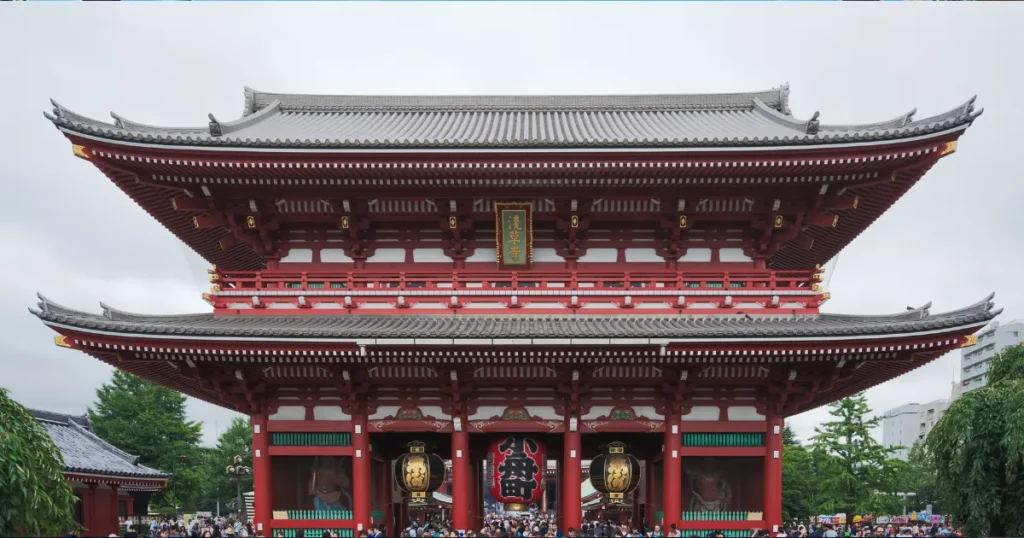
Hozomon Gate is often overlooked despite its importance within the Sensoji complex. It marks the transition from the bustling commercial area of Asakusa to the sacred heart of the temple.
https://www.senso-ji.jp/english/
Understanding this role changes the way visitors experience the site.
Unlike the decorative outer gate, Hozomon Gate represents protection rather than welcome, setting the spiritual tone before reaching the main hall.
What Is Hozomon Gate?
Hozomon Gate functions as the inner gate of Sensoji Temple, standing directly in front of the main hall.
It defines the boundary between ordinary urban life and religious space.
Passing through the gate symbolizes a mental and spiritual shift, preparing visitors for worship and reflection.
Difference Between Hozomon Gate and Kaminarimon
Many first-time visitors confuse Hozomon Gate with Kaminarimon, but their purposes differ significantly.
One serves as an iconic landmark, while the other fulfills a functional and spiritual role.
| Feature | Kaminarimon | Hozomon Gate |
|---|---|---|
| Role | Outer symbolic entrance | Inner protective gate |
| Atmosphere | Lively and festive | Calm and imposing |
| Structure | Wooden appearance | Reinforced concrete |
| Guardians | Wind and Thunder gods | Niō guardian statues |
Hozomon Gate History
The present-day appearance of Hozomon Gate reflects centuries of rebuilding and adaptation.
Its history closely parallels Tokyo’s experience with fire, war, and modernization.
Rather than preserving a single original form, the gate has evolved while maintaining its core purpose.
The key theme in its history is continuity through reconstruction, rather than unbroken physical preservation.
Edo Period Origins and Fires
Originally built during the Edo period, Hozomon Gate was constructed from wood like most temple structures of the time.
Repeated fires in Edo led to its destruction multiple times.
Each rebuilding reinforced the gate’s importance as a spiritual and architectural anchor of Sensoji.
Postwar Reconstruction and Modern Materials
The current structure was completed in 1964 after wartime destruction.
Reinforced concrete was chosen to improve fire resistance and durability while preserving traditional form.
This approach reflects postwar Japan’s balance between heritage and practicality.
Hozomon Gate Architecture: Design, Structure, and Materials
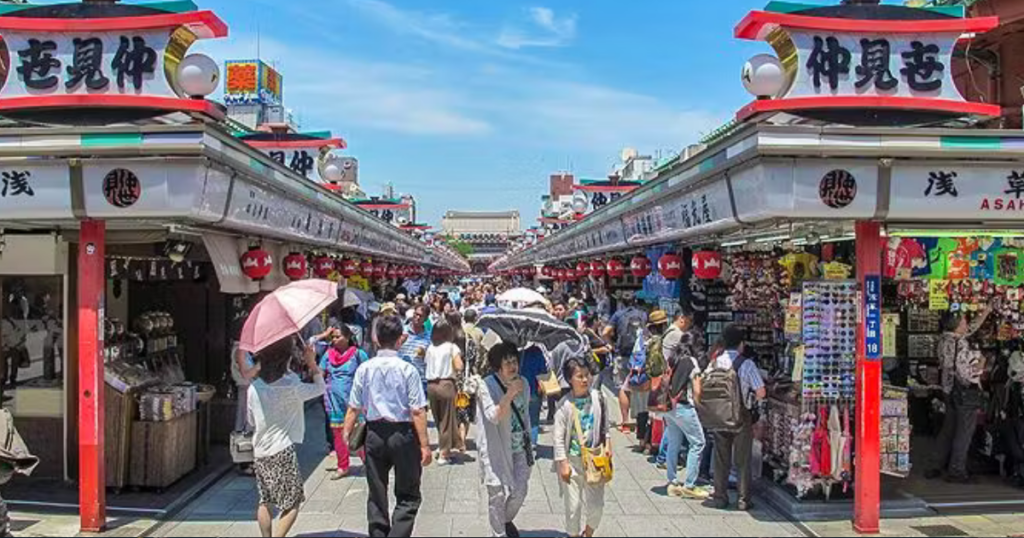
Hozomon Gate is one of the most solid and imposing temple gates in Japan. Its design prioritizes stability and protection over decorative detail.
This architectural philosophy becomes clear when observing the gate from both the front and rear.
The defining feature of the structure is its emphasis on strength rather than ornamentation.
Massive Structure and Protective Design
The gate stands at approximately 22 meters in height, commonly cited within a range of 21.7 to 22.7 meters depending on the source.
Its thick central passage and enclosed upper level give it a heavy, grounded presence.
The design reflects its role as a protective structure rather than a ceremonial one.
Materials: Why Reinforced Concrete Matters
Using reinforced concrete allows the gate to withstand fire while maintaining a traditional silhouette.
This material choice is typical of major temple reconstructions in postwar Japan.
Recognizing this helps visitors understand the gate as a living structure adapted for longevity.
Hozomon Gate Guardians: Nio Statues and Their Meaning
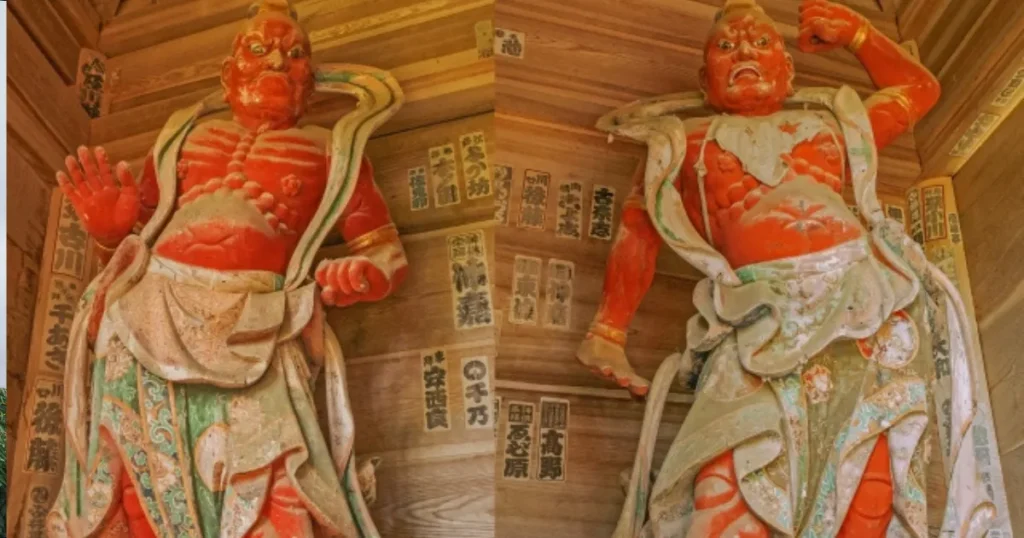
Standing on either side of the gate are two powerful Niō guardian statues. Their intense expressions often surprise visitors encountering them up close.
These figures are not decorative but symbolic, representing spiritual authority and vigilance.
The statues’ primary role is to guard the inner temple from negative influences.
The Nio Guardians: Agyo and Ungyo
The two statues embody complementary forces within Buddhist belief.
Agyō, with an open mouth, symbolizes the beginning of all things.
Ungyō, with a closed mouth, represents completion and balance.
Symbolism and Buddhist Protection Concepts
Together, the guardians form a spiritual barrier at the entrance to the inner temple.
They serve as a visual reminder that respect and awareness are required beyond this point.
This reflects the Buddhist concept of sacred boundaries within temple spaces.
Hozomon Gate Storage: The Hidden Role Behind the Gate
Beyond its symbolic meaning, Hozomon Gate also fulfills a practical function within Sensoji Temple.
Its enclosed upper level is designed for secure storage rather than public access.
The most overlooked aspect of the gate is its role as a protective repository.
Sensoji’s Sutras and Cultural Assets
Important Buddhist sutras and ritual objects are kept inside the gate.
Housing them here provides both physical security and symbolic protection.
This explains the gate’s solid, enclosed architectural form.
Hozomon Gate Photo Spots and Best Angles
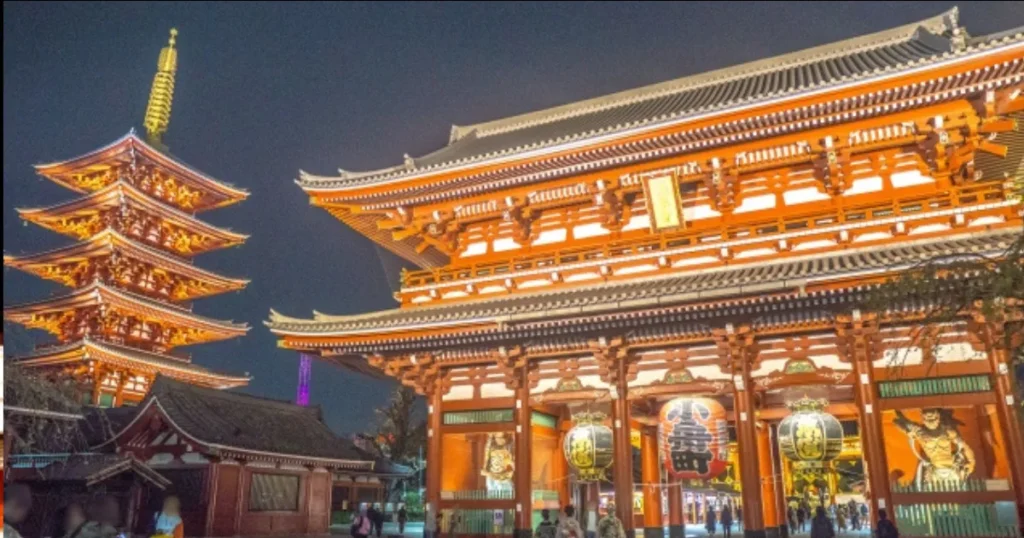
Compared to the crowded Kaminarimon, Hozomon Gate offers a calmer environment for photography.
Its position closer to the main hall also allows for more balanced compositions.
The key advantage for photographers is the reduced crowd density.
Front View vs Rear View Photography
From the front, the Niō statues dominate the frame and convey scale.
From the rear, the relationship between the gate and the main hall becomes clear.
Both angles highlight different architectural intentions.
Seasonal Lighting and Crowd Avoidance Tips
Early mornings provide softer light and fewer people.
Late afternoon creates strong shadows that emphasize structure.
Midday on weekends is generally the most crowded time.
Hozomon Gate Access: How to Reach It Easily
Hozomon Gate is easy to reach and fits well into short sightseeing itineraries.
Its location makes it a natural stopping point for first-time visitors to Asakusa.
The simplest route is to follow the traditional approach through Nakamise Street.
From Asakusa Station to Hozomon Gate
From Asakusa Station, follow signs toward Sensoji Temple.
Walk through Nakamise Street and pass Kaminarimon.
Hozomon Gate appears immediately before the main hall.
Hozomon Gate vs Other Famous Temple Gates in Japan
Placing Hozomon Gate in a national context helps clarify its uniqueness.
Unlike many gates known for size or decoration, its identity lies in function.
What sets it apart is the combination of modern materials and traditional purpose.
| Gate | Location | Defining Feature |
|---|---|---|
| Hozomon Gate | Tokyo | Protective inner gate |
| Kaminarimon | Tokyo | Symbolic outer entrance |
| Nandaimon | Nara | Monumental wooden structure |
Tips for First-Time Visitors to Hozomon Gate
A mindful approach enhances the experience of visiting Hozomon Gate.
Even a short stop can be meaningful when attention is given to detail.
The most important point is to slow down and observe before passing through.
Etiquette, Timing, and Short-Stay Advice
Avoid blocking the central passage when walking through the gate.
Allow 10 to 15 minutes to view the statues and structure.
Combining the visit with nearby Asakusa food and culture creates a balanced itinerary.
Japan Trails Newletter